
CASE STUDIES
Creative problem-solving beyond the finished product.
Design is only part of bringing a product to market. These case studies look behind the finished work at three very different challenges—scaling a major licensed program, engineering a complex production workflow, and navigating an unusually disrupted production cycle.
Each required a different combination of creative direction, product development, workflow design, production management, and problem-solving.
01 — NASCAR
Scaling a Major Licensed Product Program
Turning a growing license into a scalable, multi-format product program.
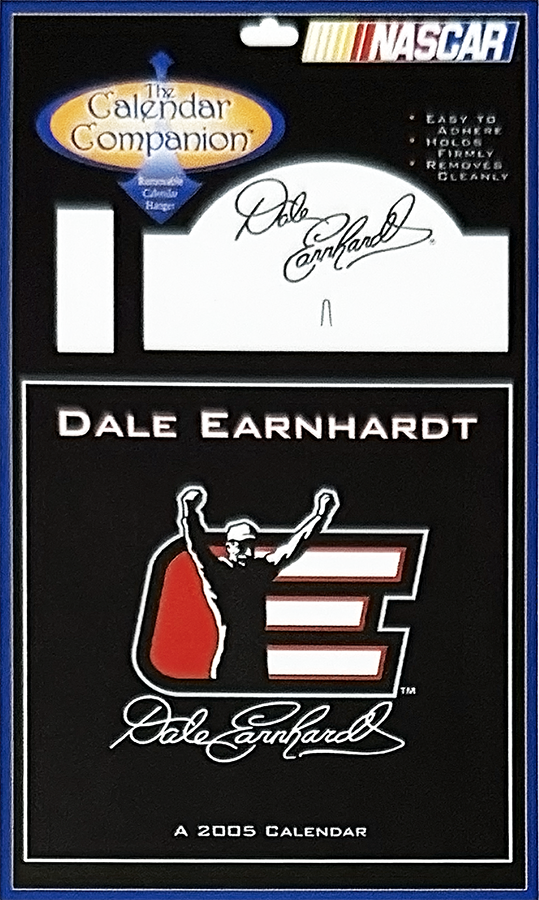
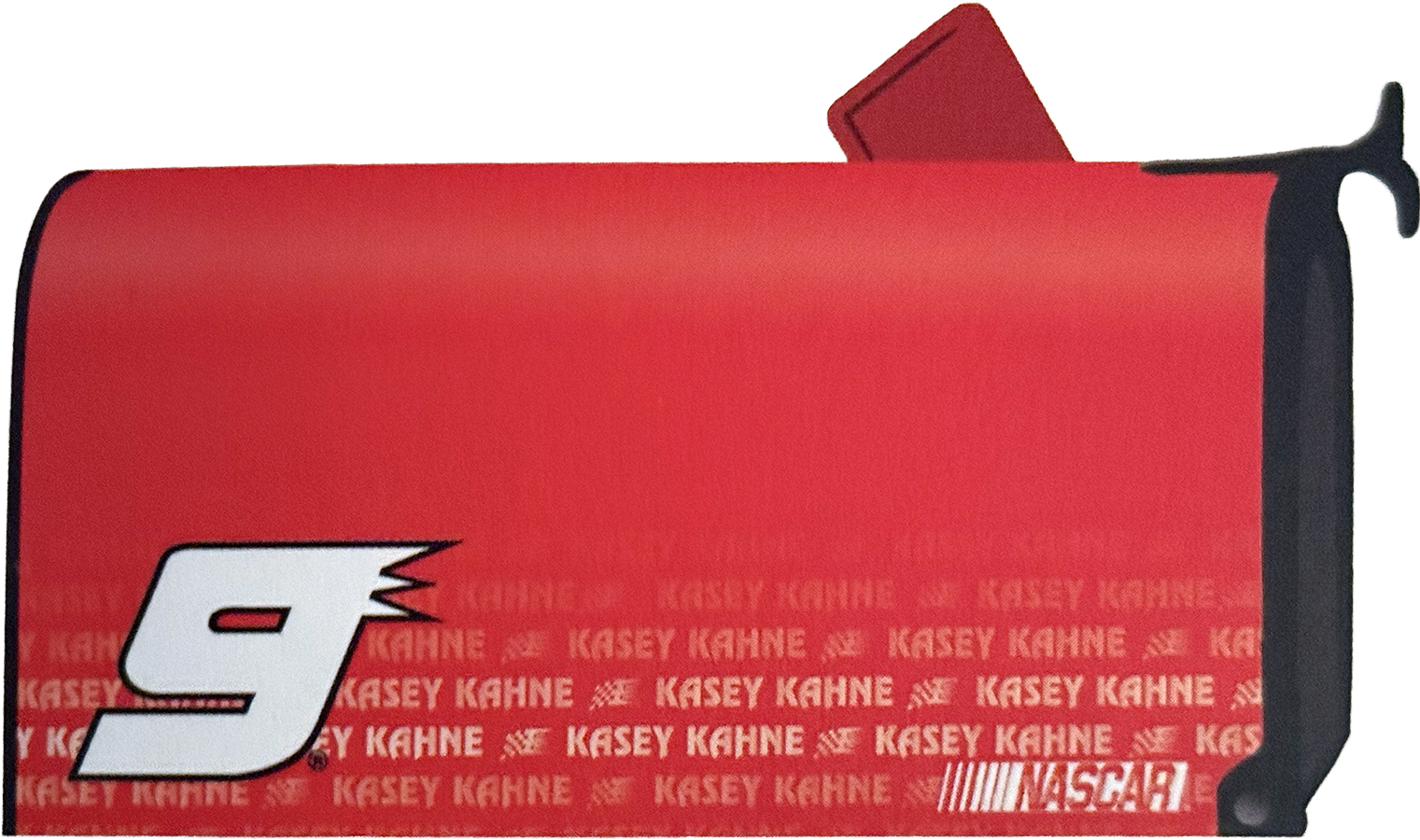
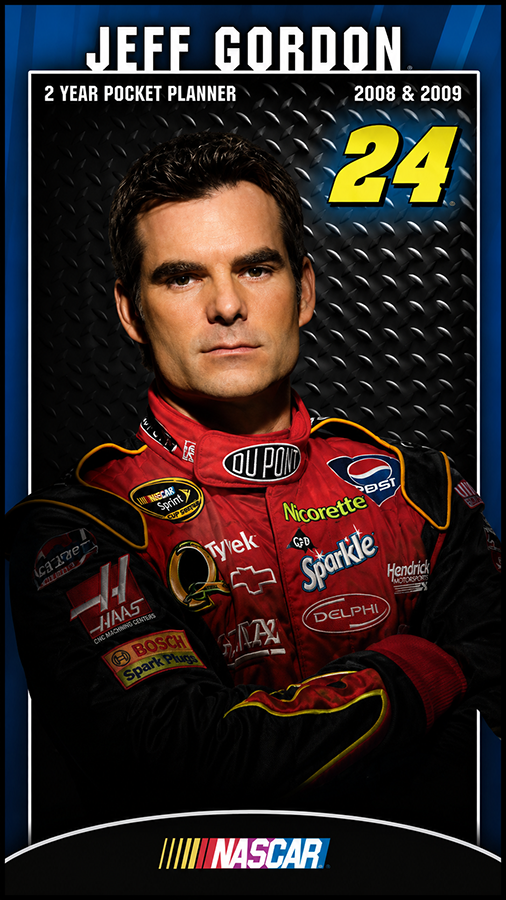
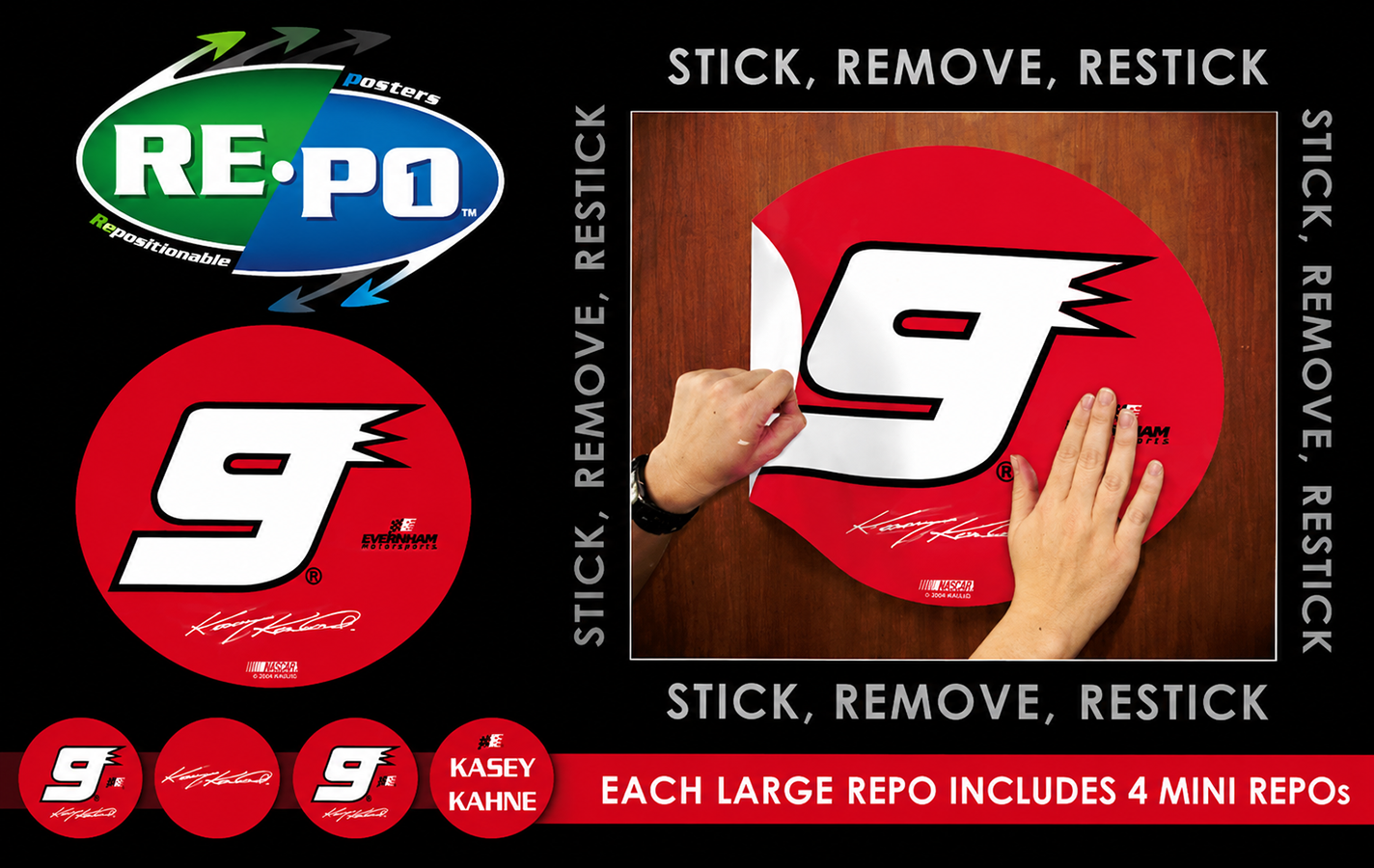
NASCAR grew from a relatively small licensed program into the largest license TF Publishing had managed in terms of product volume and format diversity. During the peak expansion years, NASCAR encouraged the development of additional products, leading us to explore new paper-product formats while continually expanding the driver assortment.
As Art Director and lead NASCAR designer, I worked across nearly every format developed for the program while directing and reviewing work produced by other designers.
Scaling Design Without Losing Identity
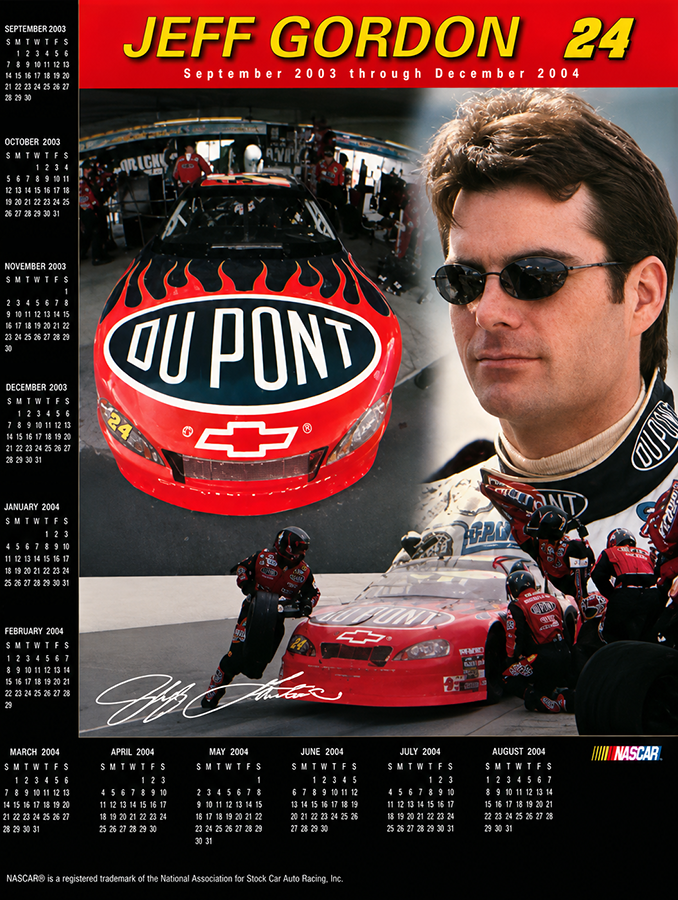
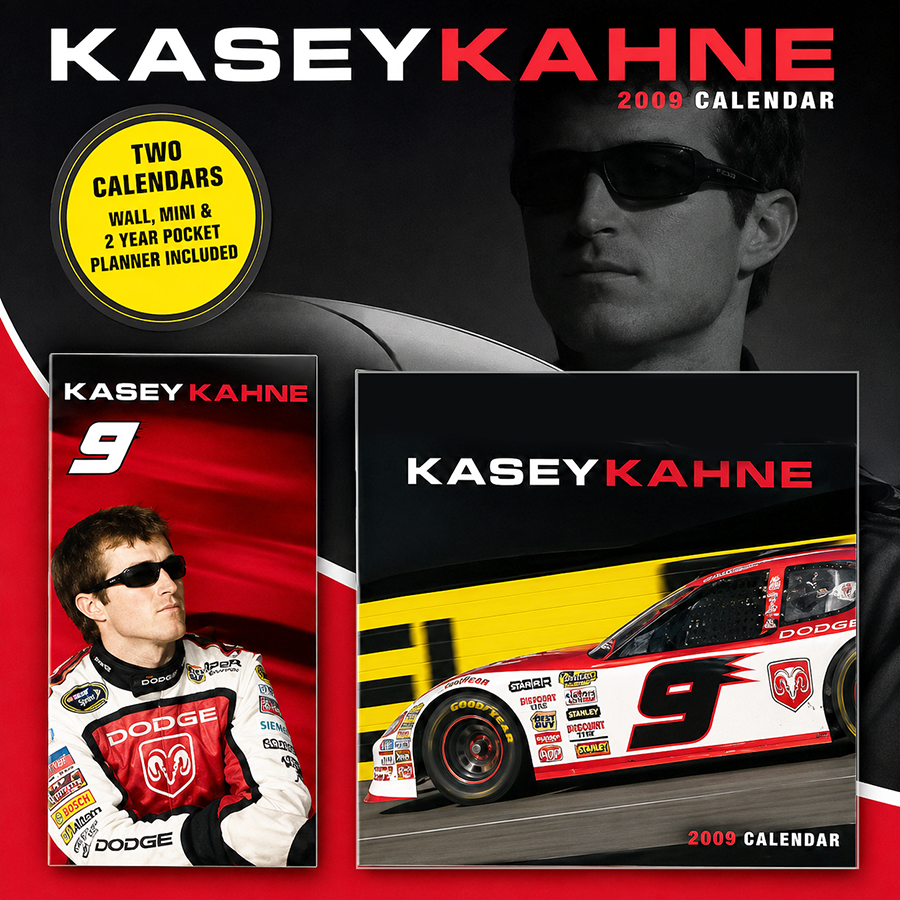
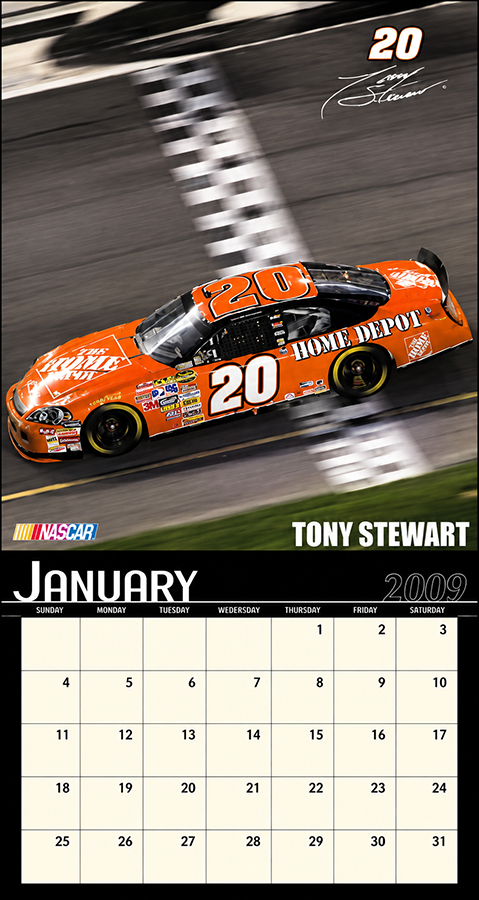
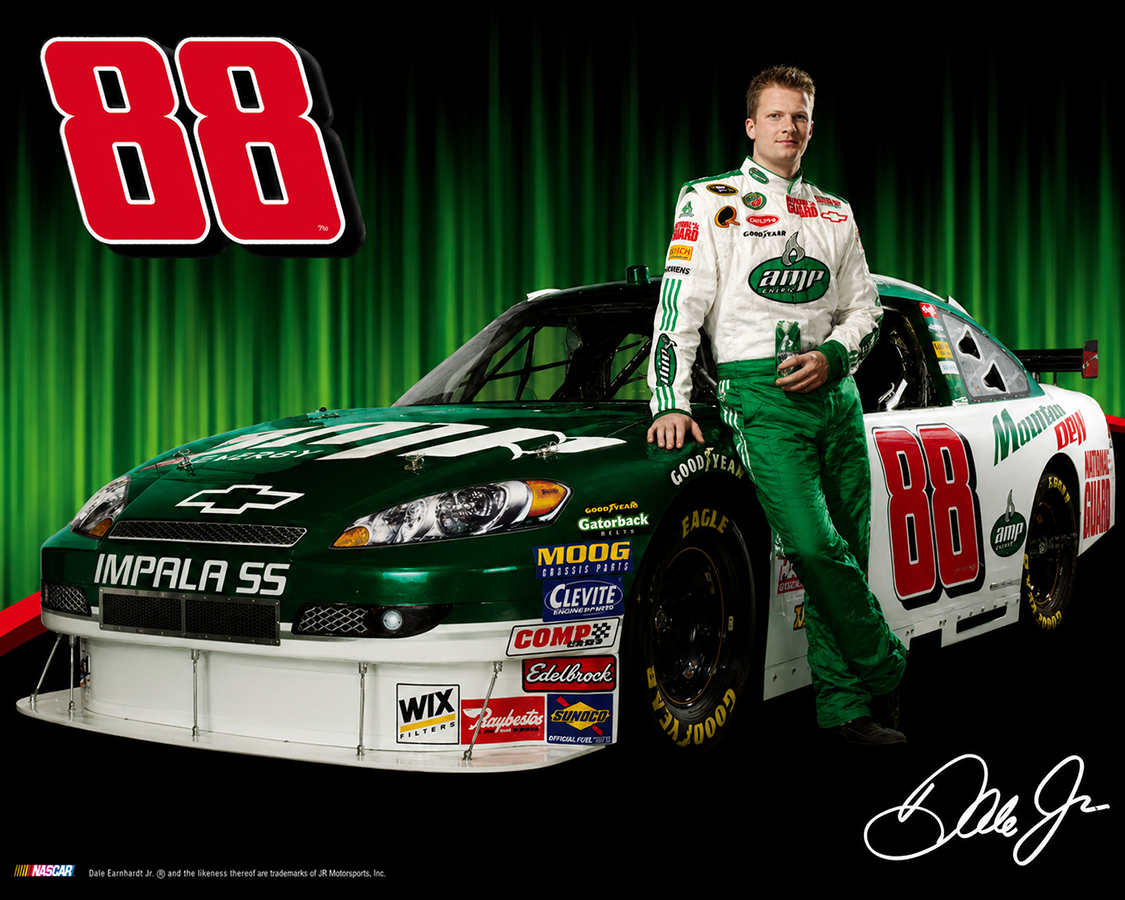
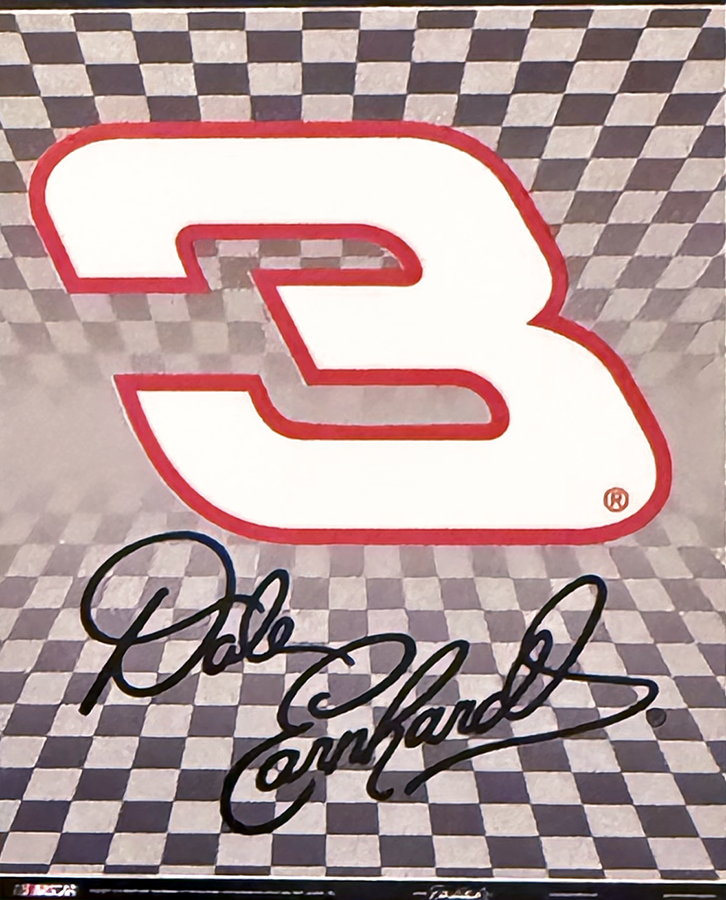
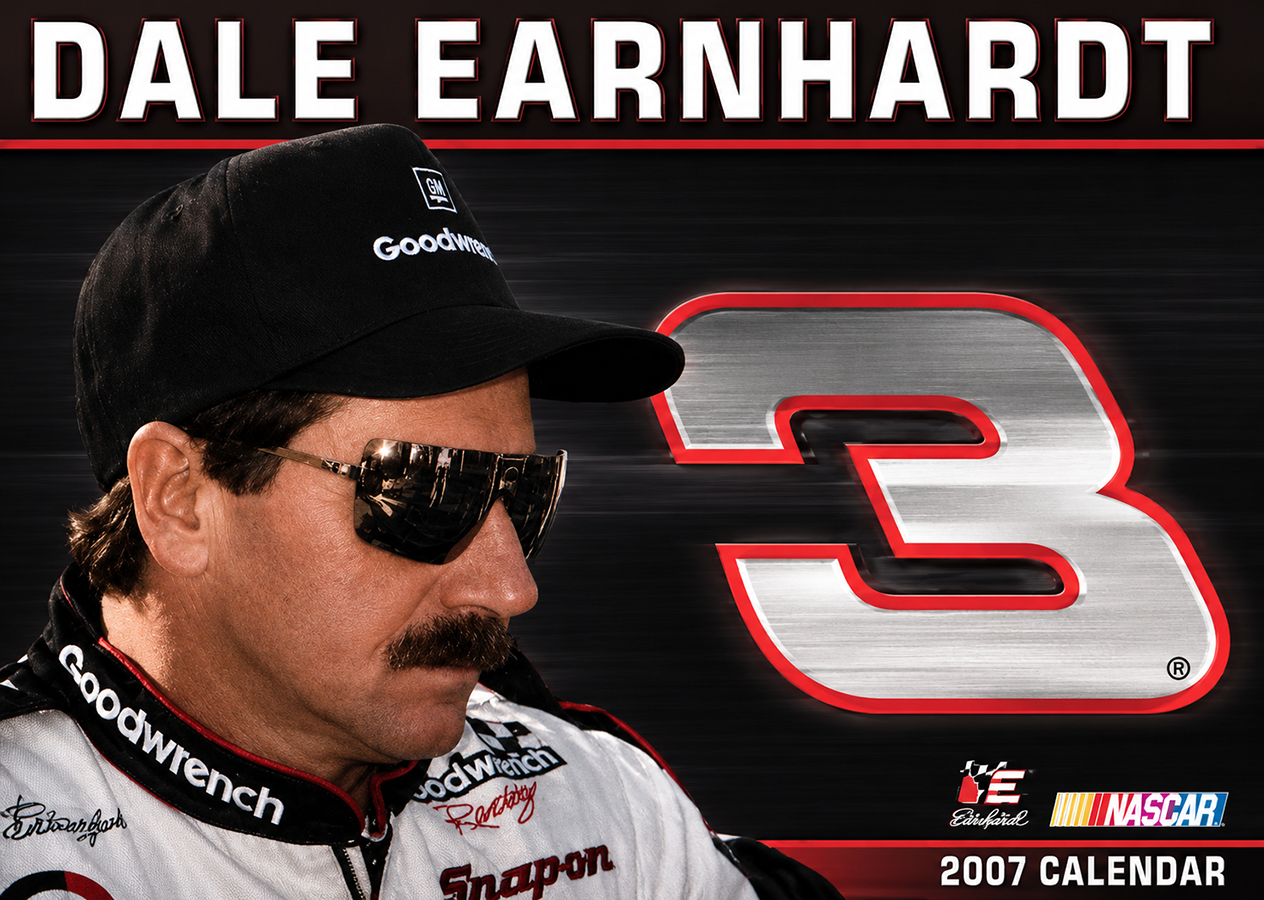
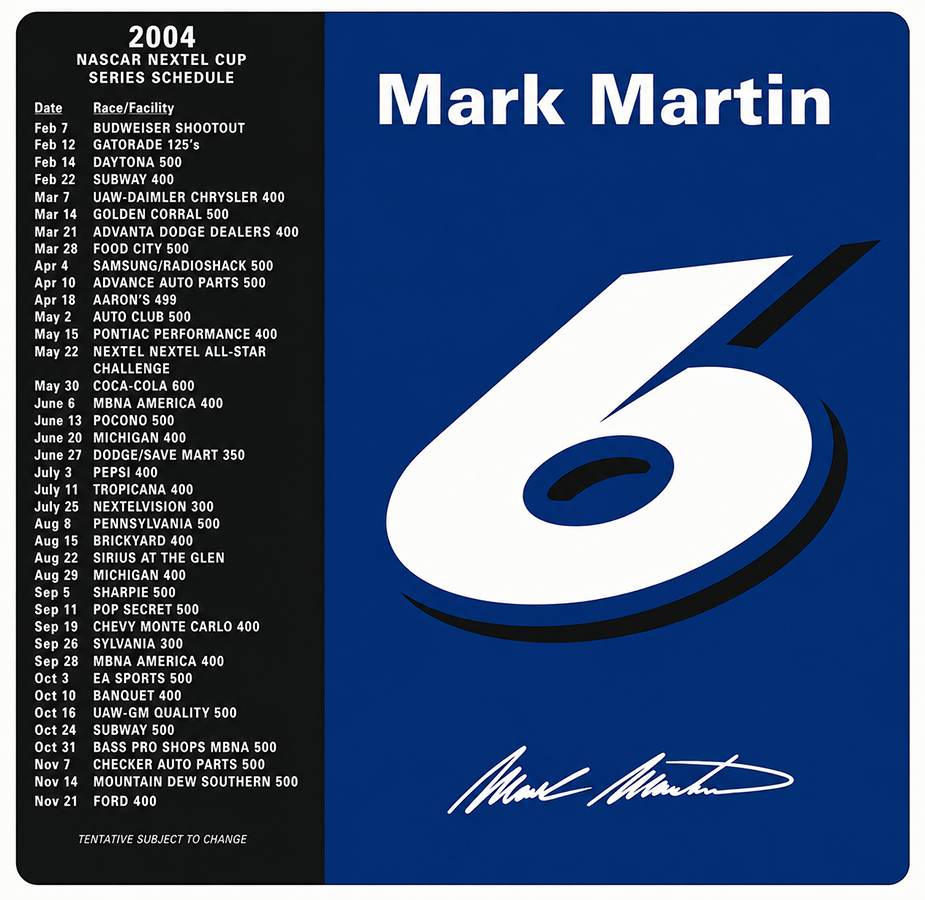
The growing assortment required a design approach that could balance efficiency with individual driver identity. Whenever possible, product families shared a common visual structure while driver numbers, signatures, colors, photography, sponsor identities, and annual style-guide elements created differentiation.
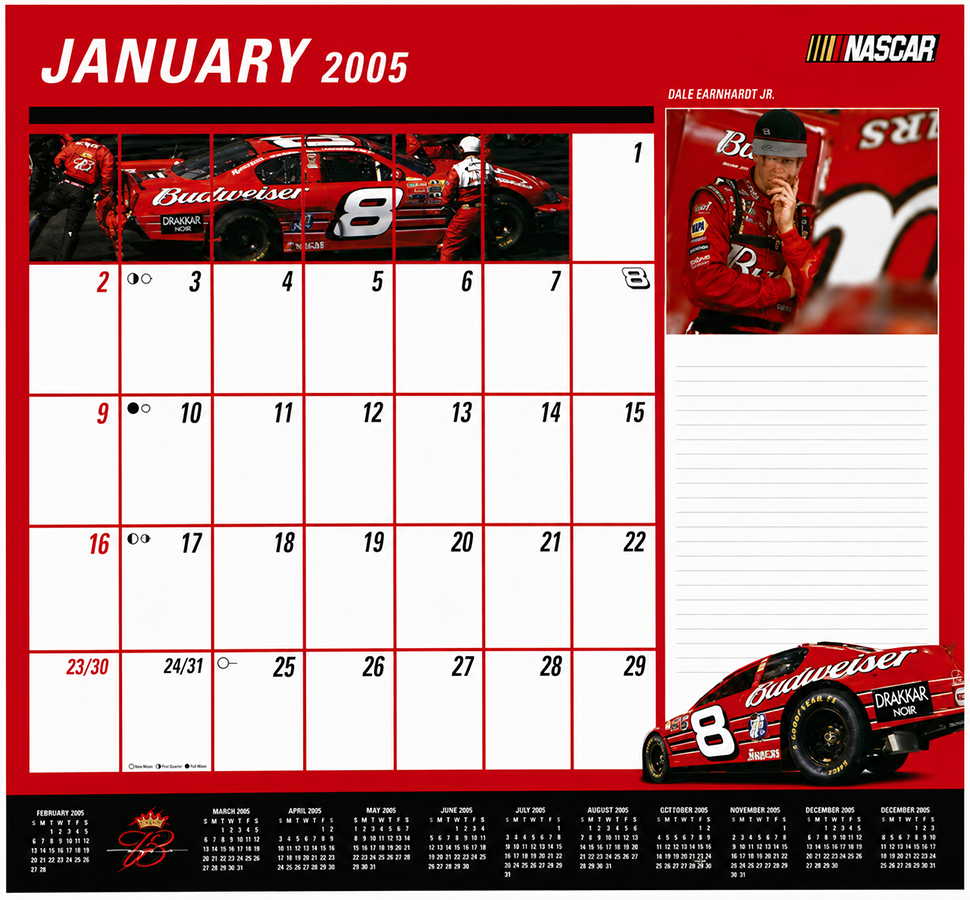
Work was divided across the design team. Early in the program, I established much of the wall-calendar direction and continued personally designing NASCAR wall calendars throughout its run. As the team developed, another designer took greater ownership of establishing the annual look for many of the driver calendars. I reviewed the initial direction before the broader assortment was developed from it and reviewed completed calendars before licensing submission.
Using a shared visual direction across related products made a large assortment more efficient to produce while also creating a stronger, more cohesive presentation at retail.
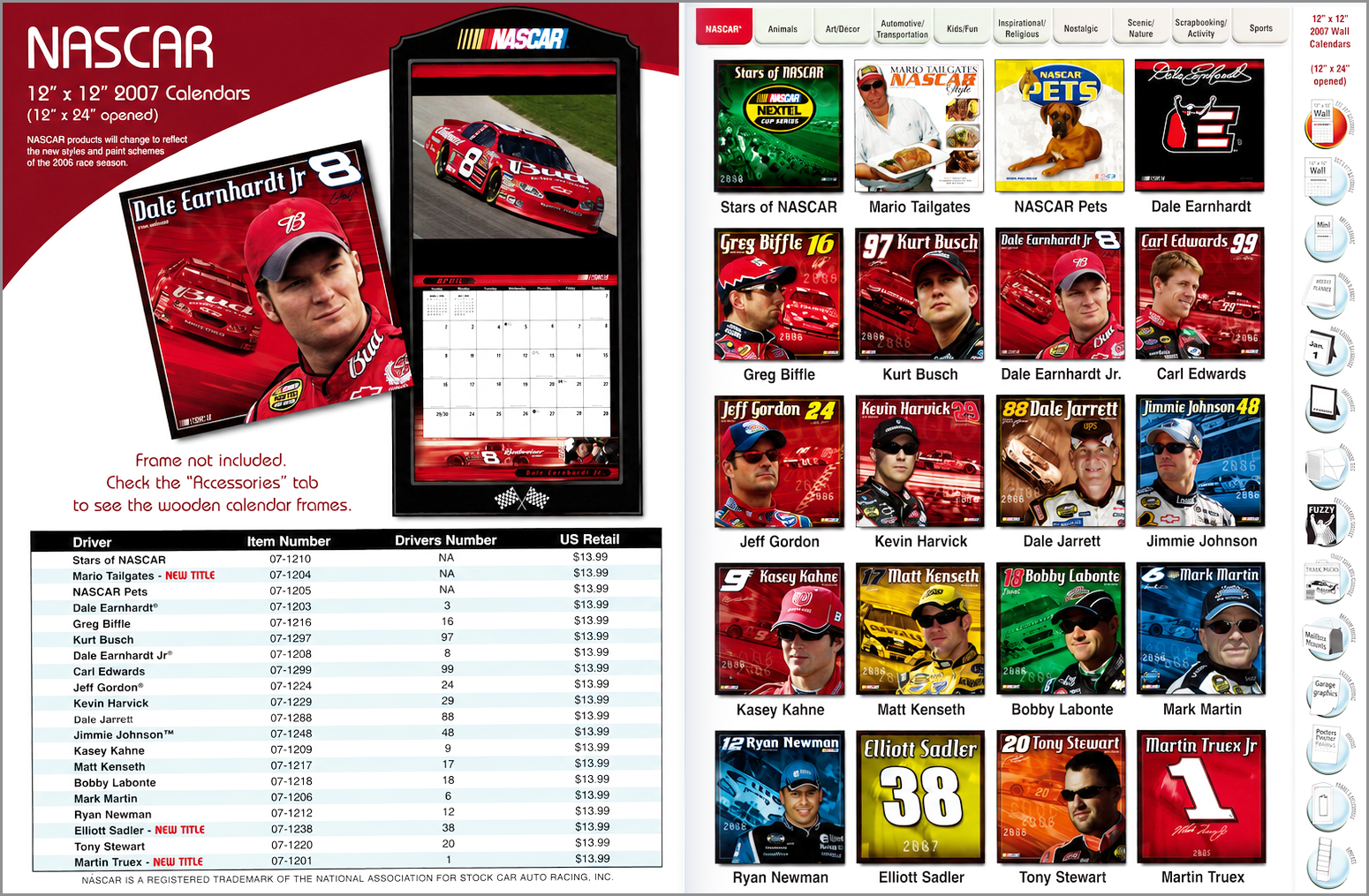
A PROGRAM BUILT AROUND 20+ DRIVERS
Individual driver identities were developed using current photography, car numbers, signatures, sponsor identities, colors, and annually updated style-guide assets.
Standardize Where Possible. Customize Where it Matters.
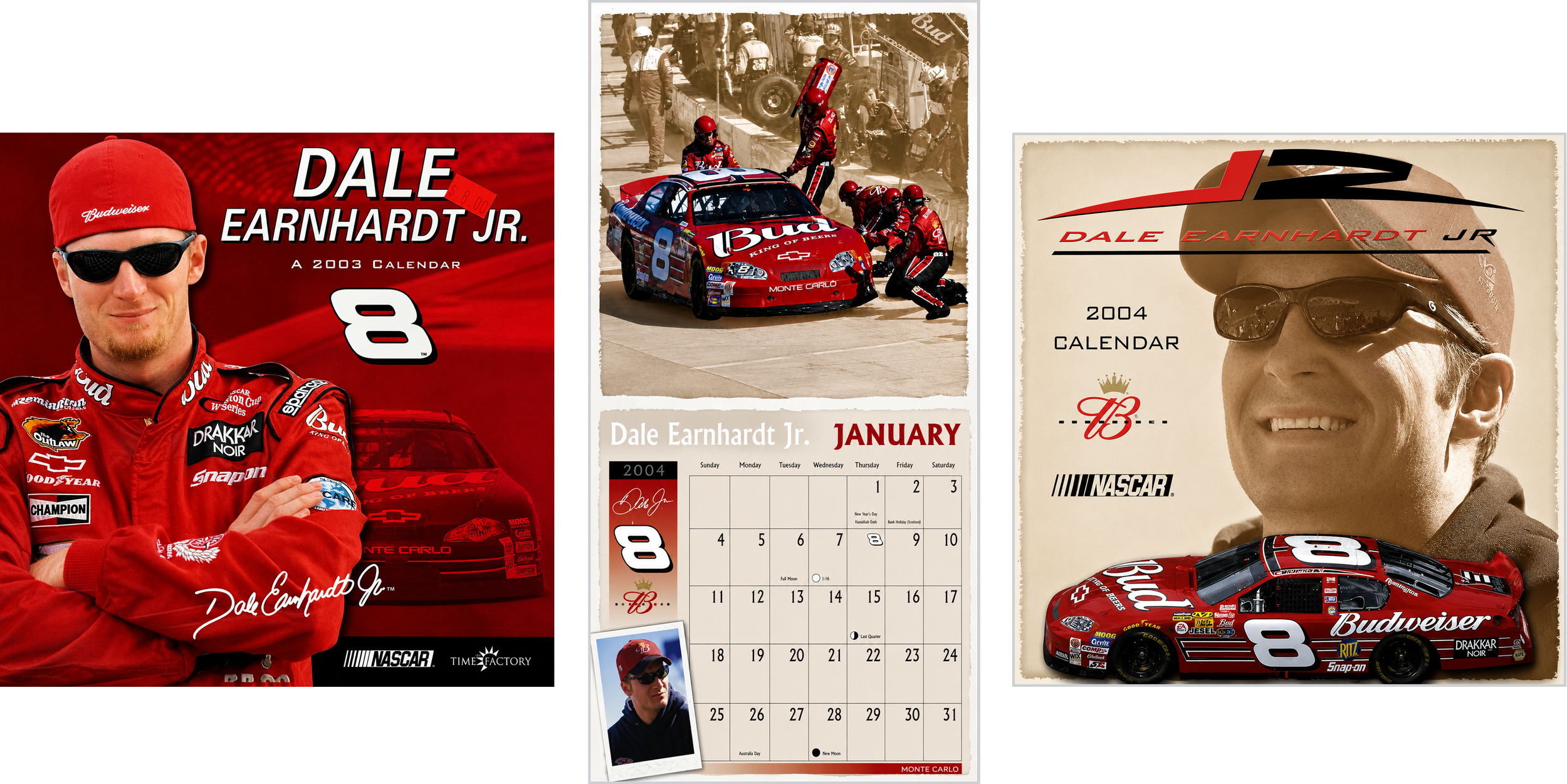
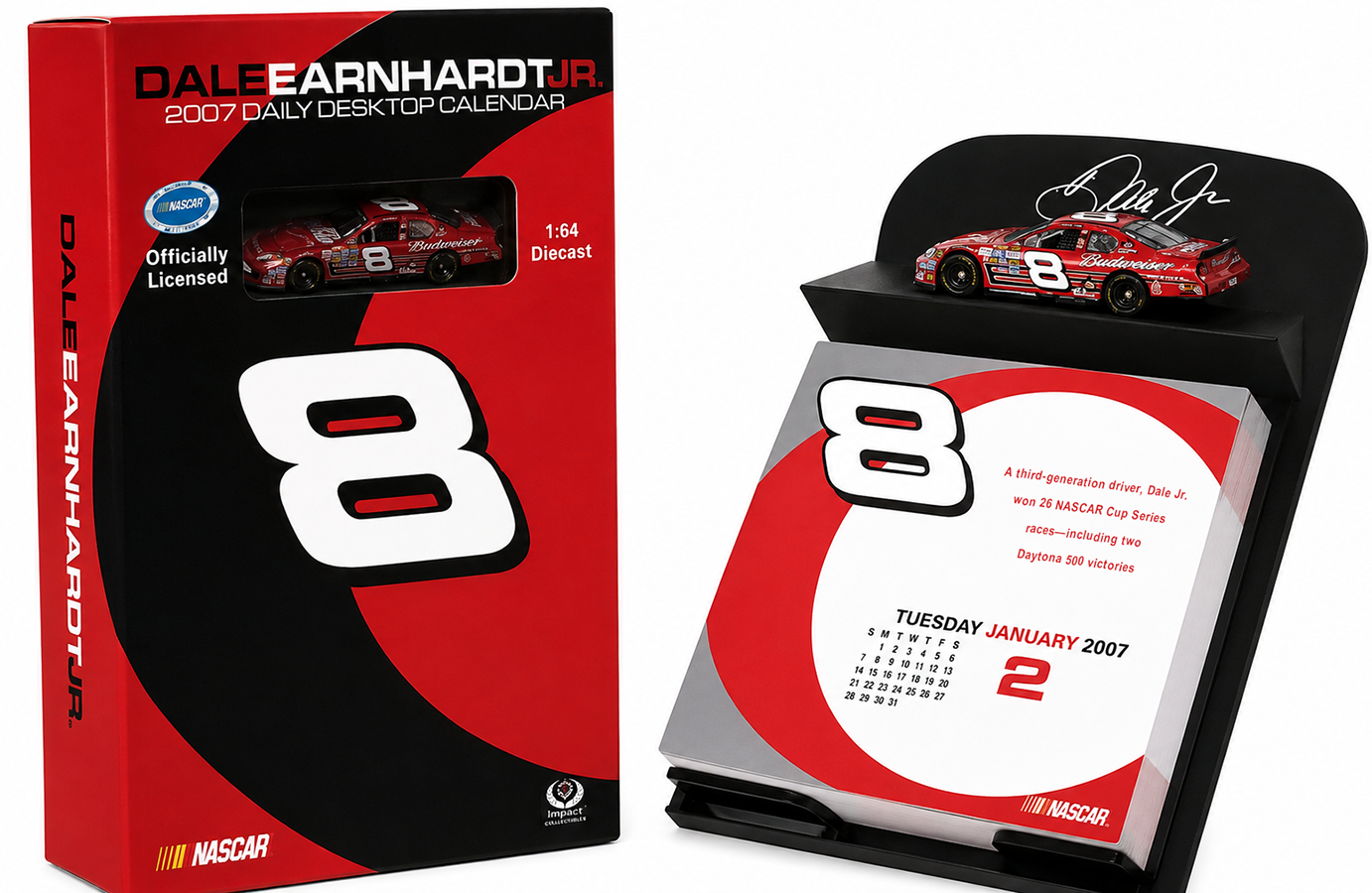
Dale Earnhardt Jr. was frequently the exception. As NASCAR's most popular driver during much of the program, his licensing team often wanted his products to stand apart from the broader NASCAR assortment.
I personally designed many of the Dale Jr. wall calendars, developing treatments specifically around his brand requirements—from the distinctive Budweiser red and crushed-ice visual treatment of one season to sepia-toned photography paired with the signature red palette in the next season.
This created an important balance within the program: use scalable systems where consistency improved efficiency and merchandising, while allowing key brands to break from the system when differentiation mattered.
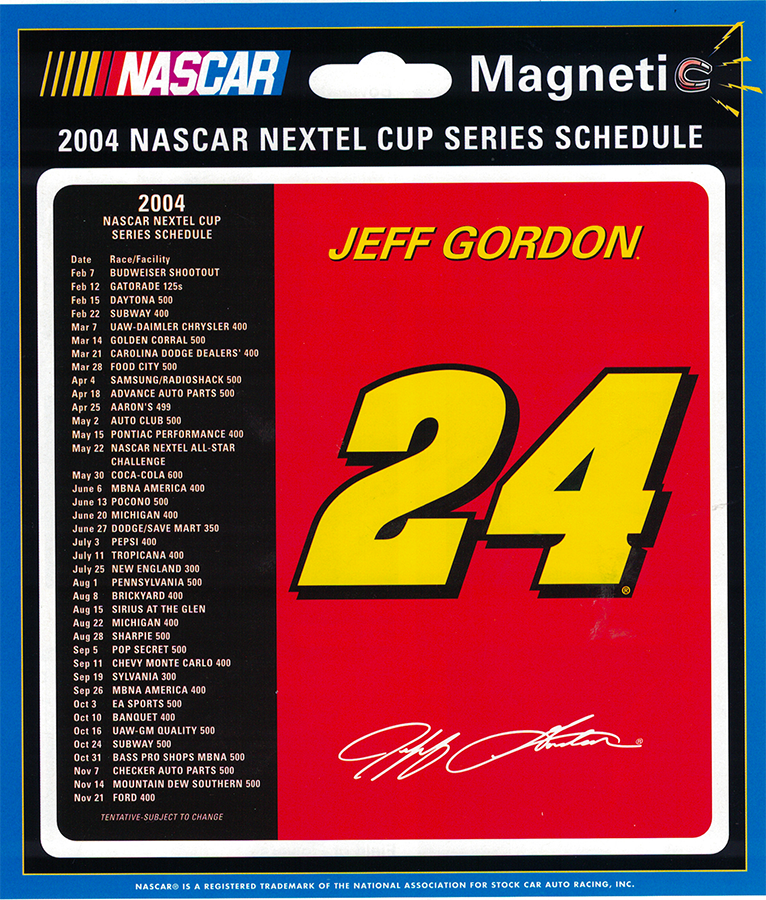
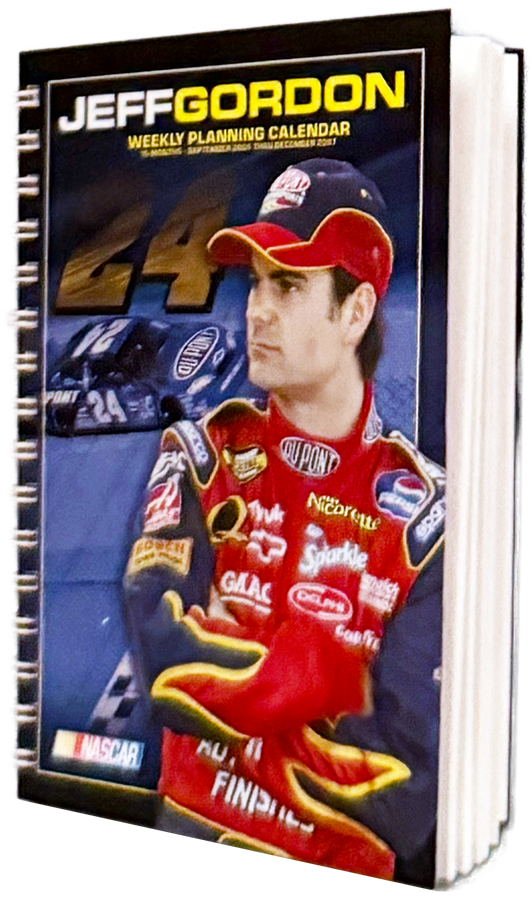
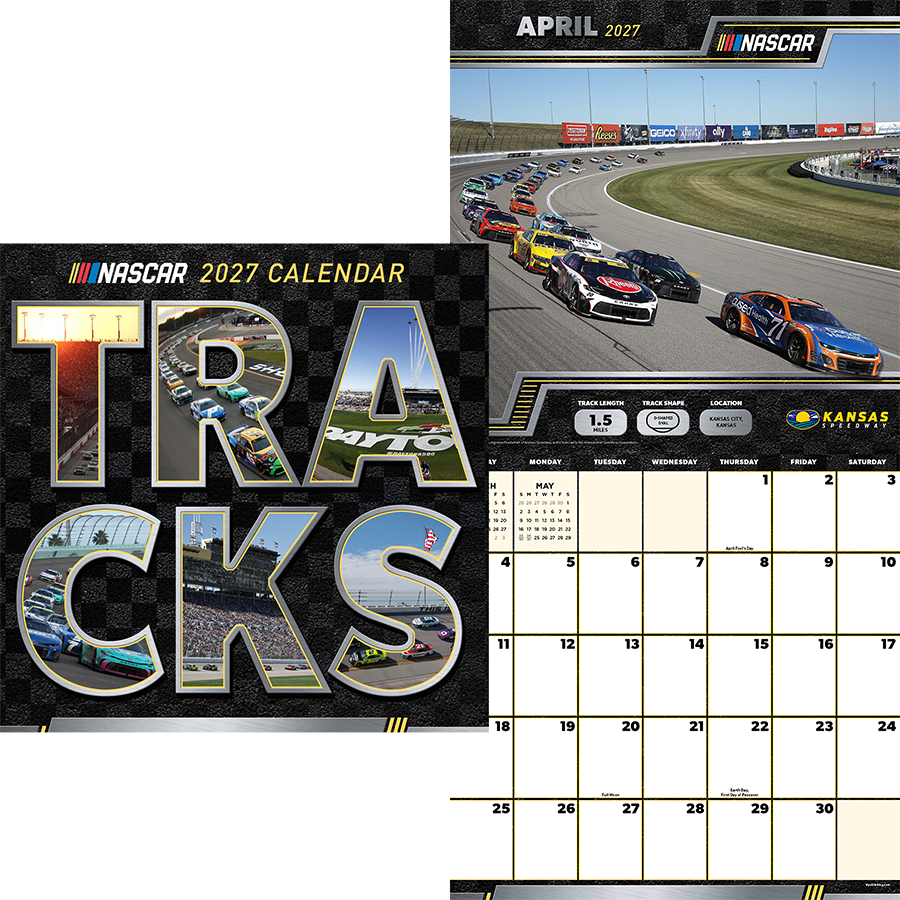
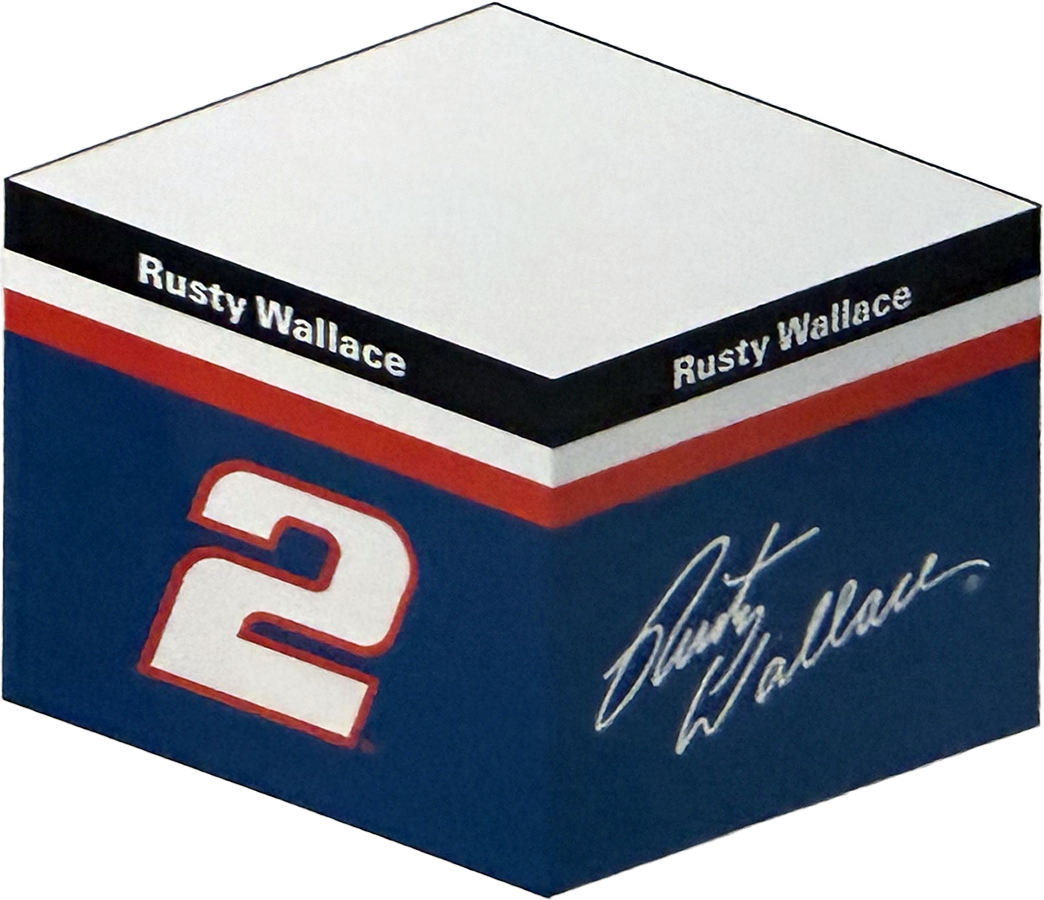
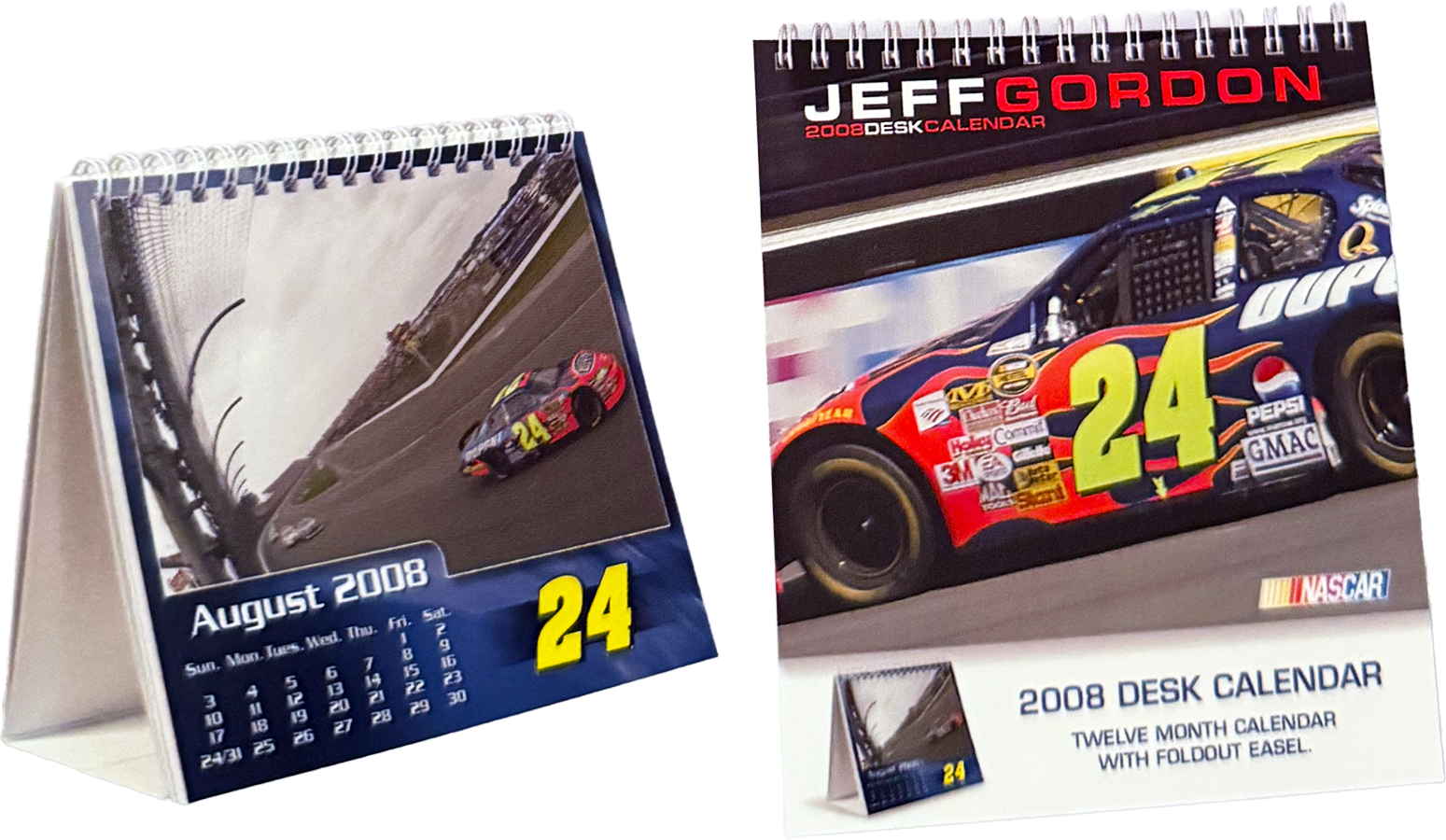
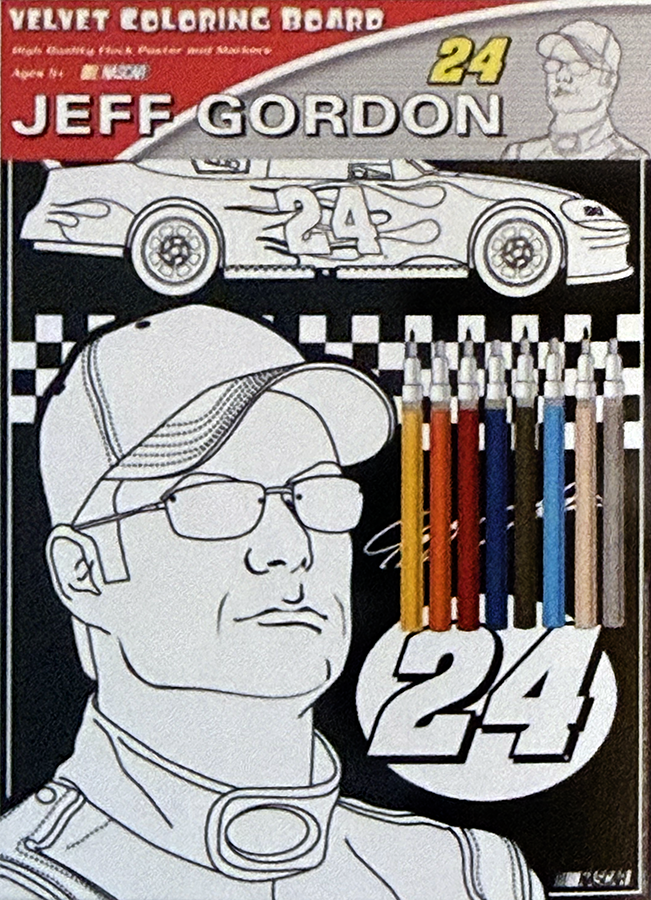
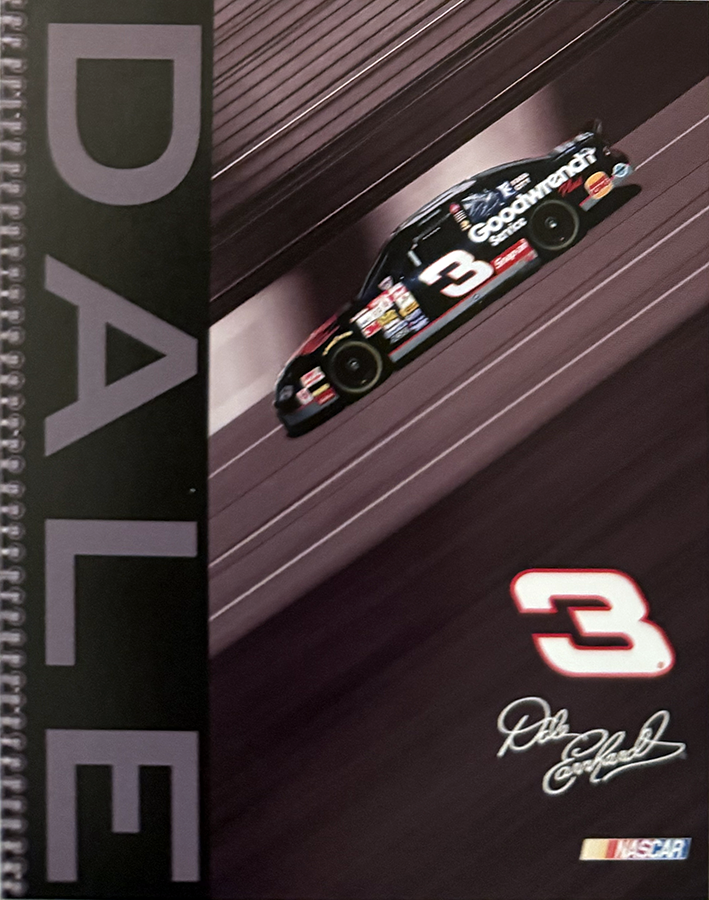
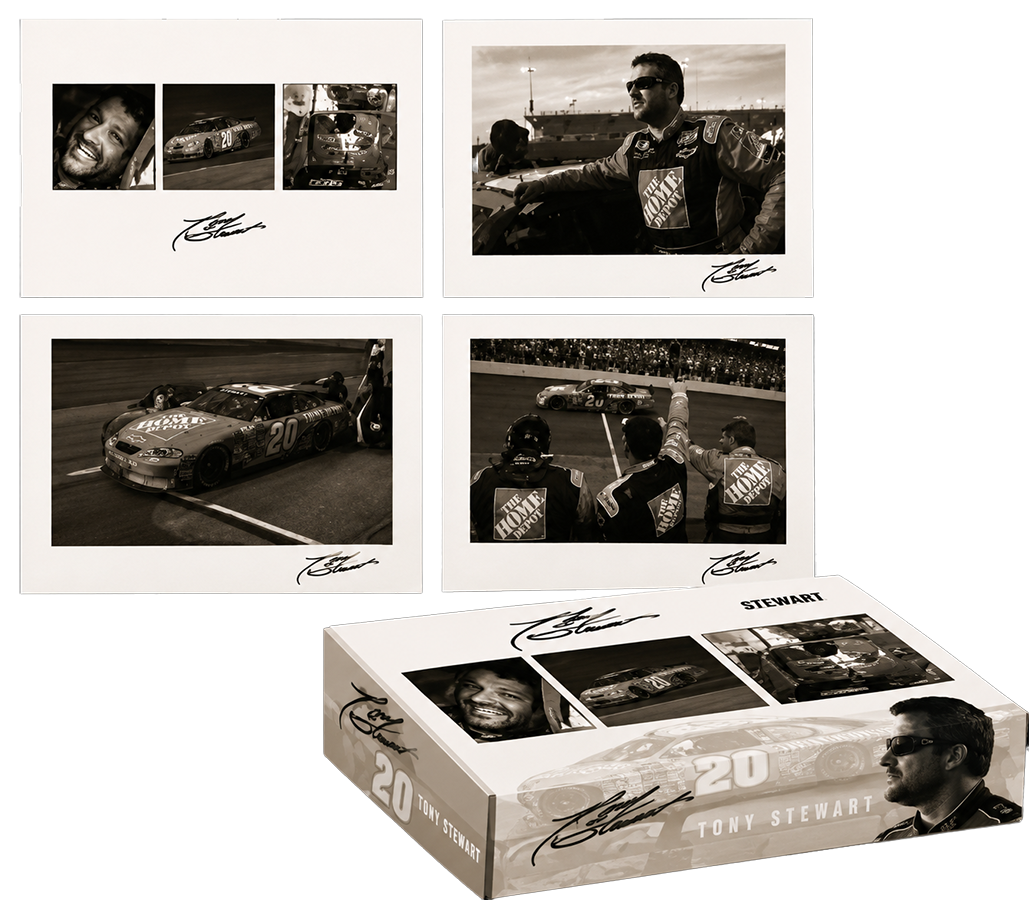
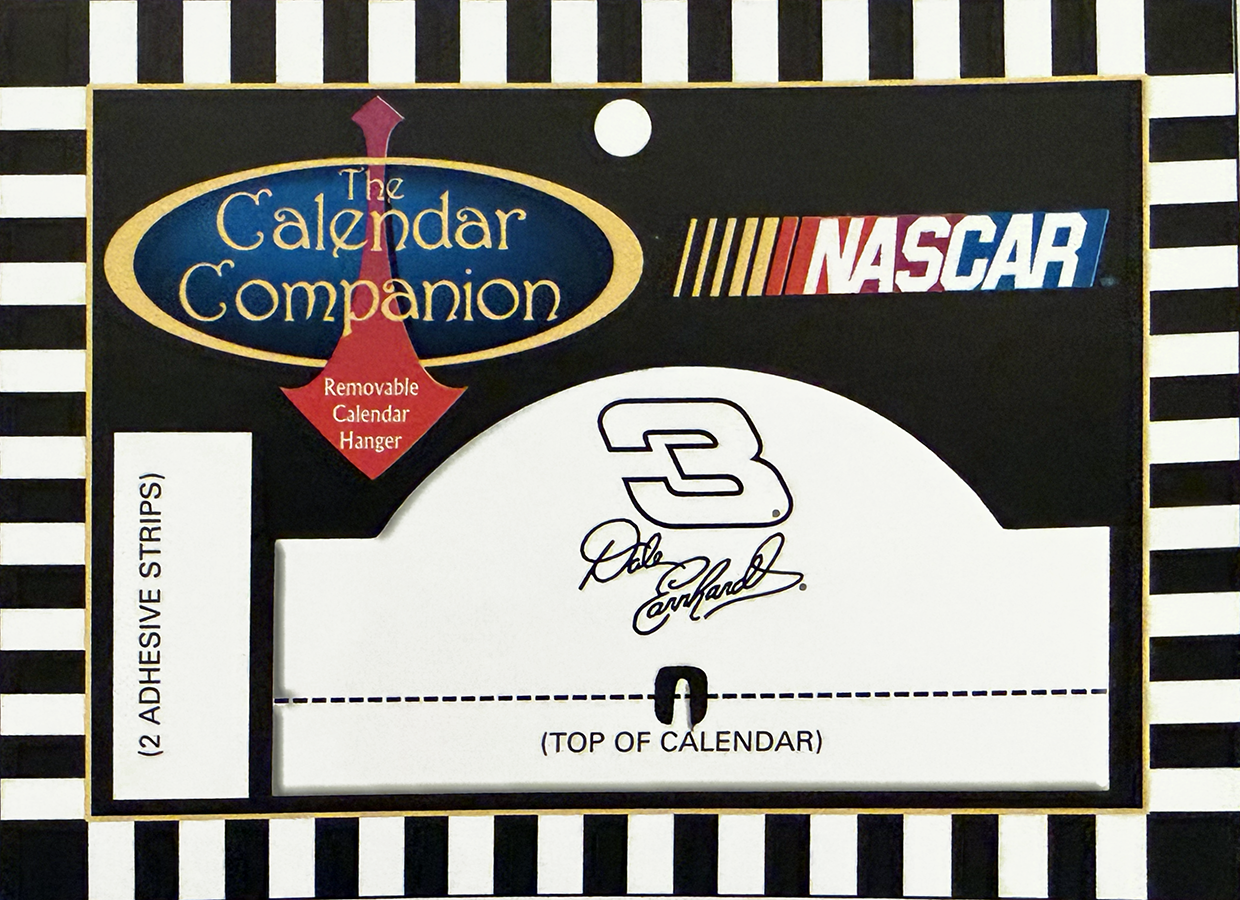
29+ Formats. One License.
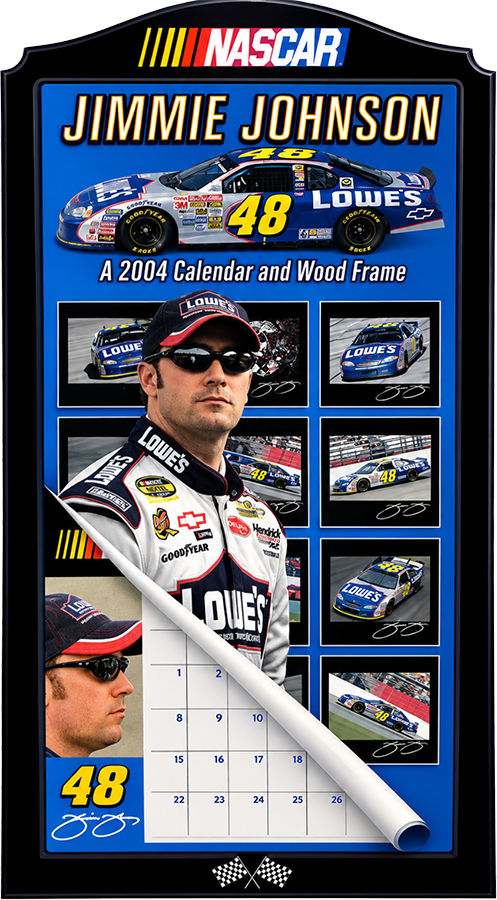
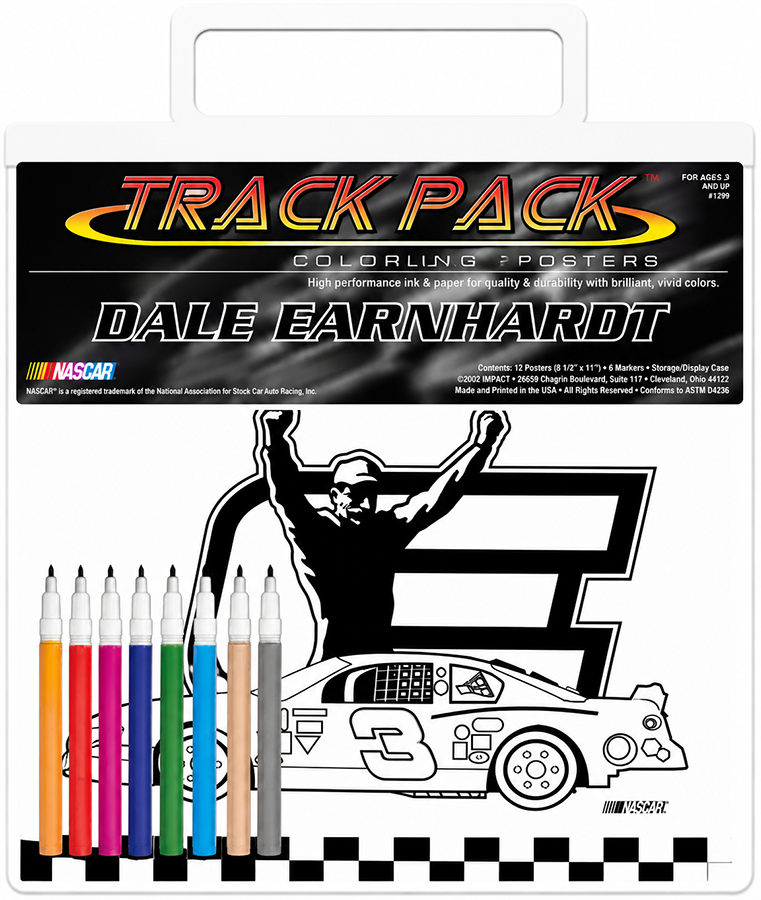
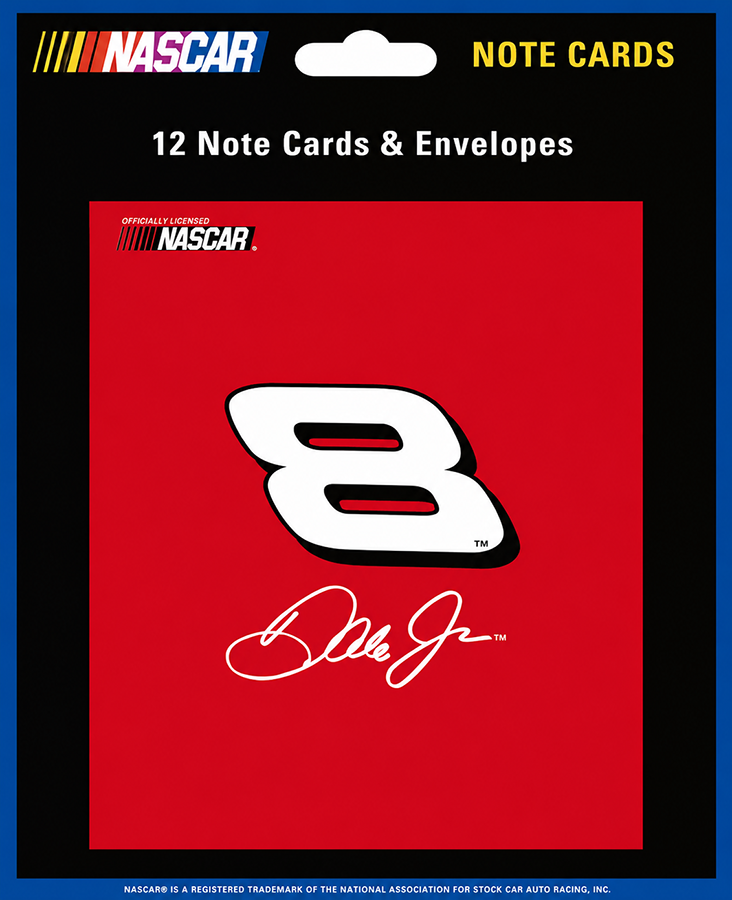
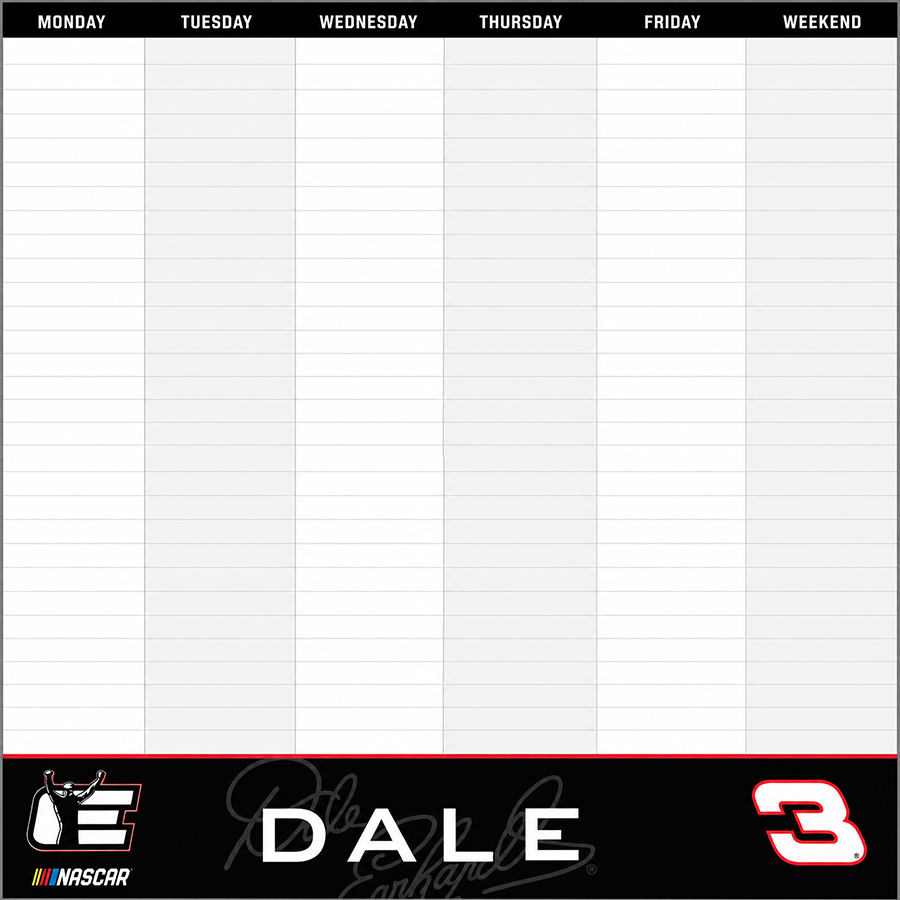
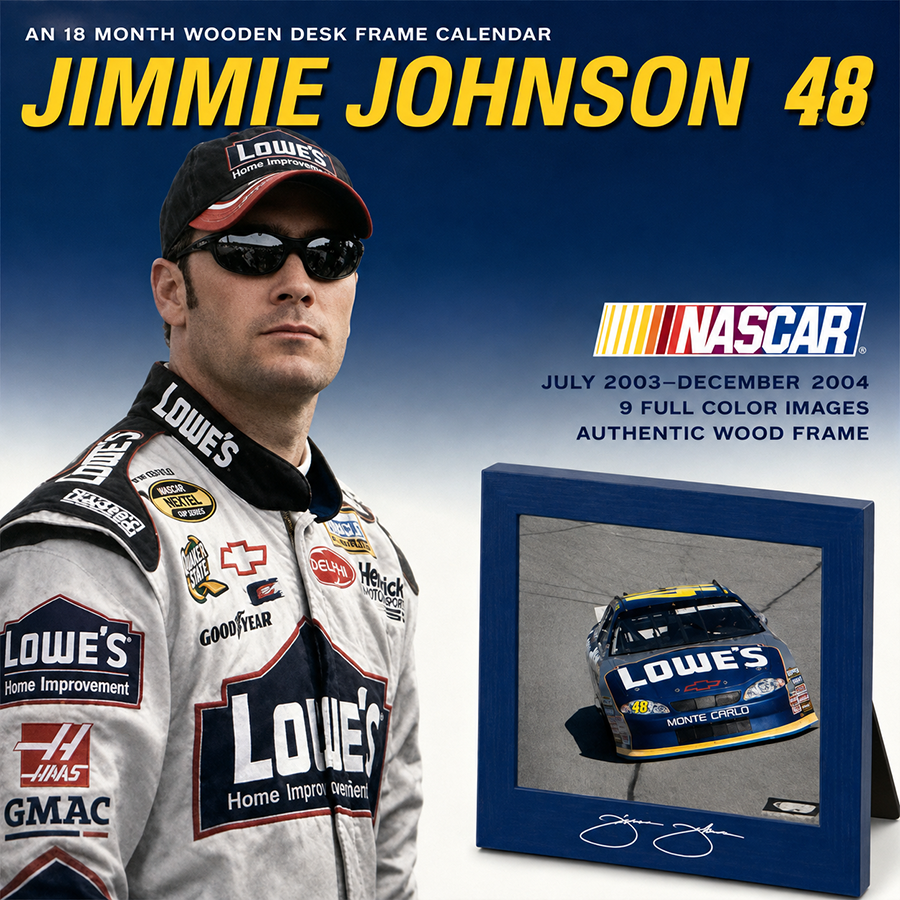
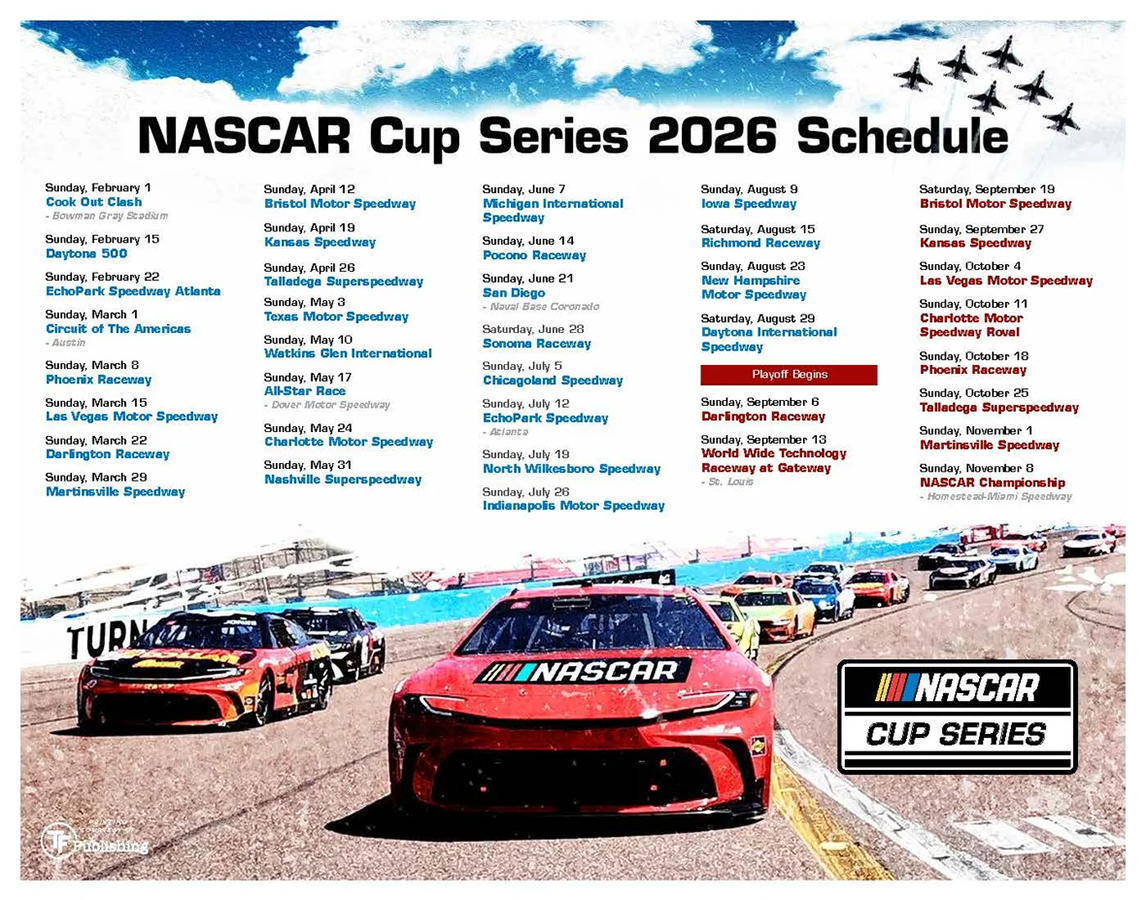
The rapid expansion of the NASCAR program went far beyond traditional wall calendars. New formats were continually explored through collaboration among sales, licensing, design, NASCAR, and manufacturing partners. I typically developed the initial design concept for new formats, creating a visual system that could then be extended across additional drivers by the design team.

Designing Around a Season That Had Already Started
NASCAR driver calendars created an unusual production challenge: photography had to feature thecurrent racing season.
Because racing did not begin until mid-February, meaningful photo selection and design often couldn't begin until late March—when much of the broader Calendar Year line was already moving through print production. Multiple paint schemes also had to be represented, requiring photography from several races.
The finished designs then moved through multiple layers of approval, including NASCAR and individual driver teams, with additional approval requirements for some drivers. Final printer files for driver calendars could extend into late May or June.
At the same time, early work on the following year's product line was already beginning.
Despite the compressed creative window, NASCAR products still had to reach retail within the same seasonal selling period as the rest of the calendar line.
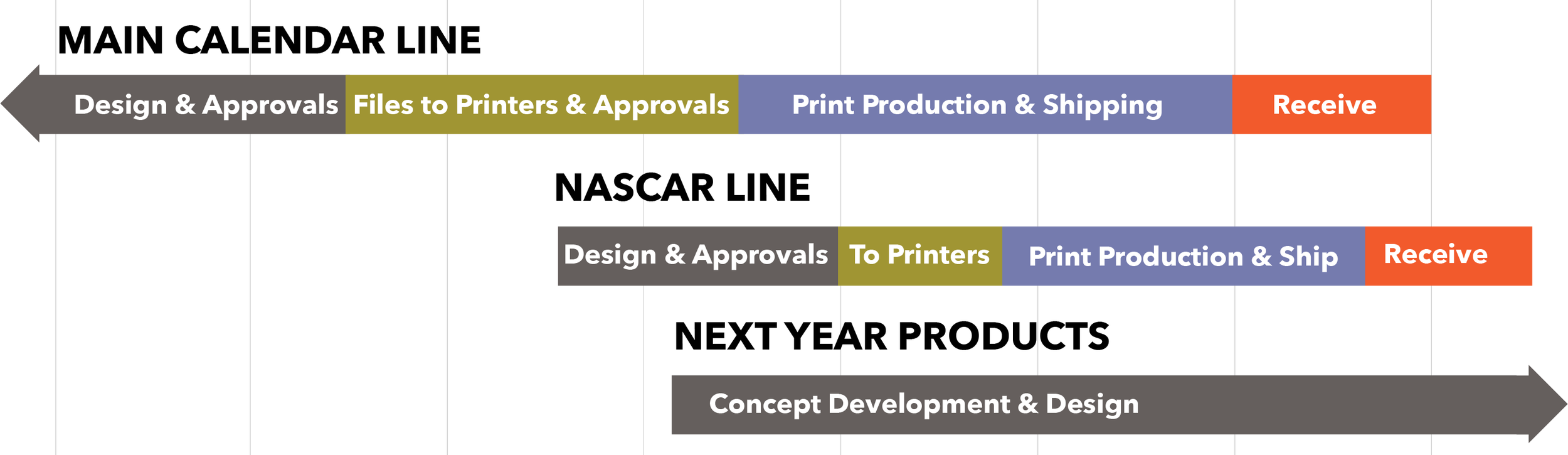
COMPRESSED PRODUCTION WINDOW
Current-season imagery pushed NASCAR development later into the production cycle, overlapping print production for the main calendar line and development of the following year's products.
Making the Work Visible
As product volume increased, workflow visibility became critical. A large-format production matrix—approximately five feet tall—hung in the shared art department, tracking the entire product line, not just NASCAR.
Every product had its own row, organized by format and alphabetically within each section. Designer assignments and key production milestones were tracked across columns. Designers physically recorded completion dates as work progressed, while Licensing added dates when products received final licensor approval.
The shared system allowed the team to see who owned each product, where it stood in the process, and what still required action. Blank rows at the bottom of sections accommodated new products as the assortment continued to evolve.
Once products reached the printer-proof stage, I routed proofs back to the designer responsible for the product so they could review their own work, maintaining ownership and accountability through production. Proof corrections and approvals were documented and retained by title, creating a production history that could verify requested revisions, deadlines, proof rounds, and printer charges when questions arose.
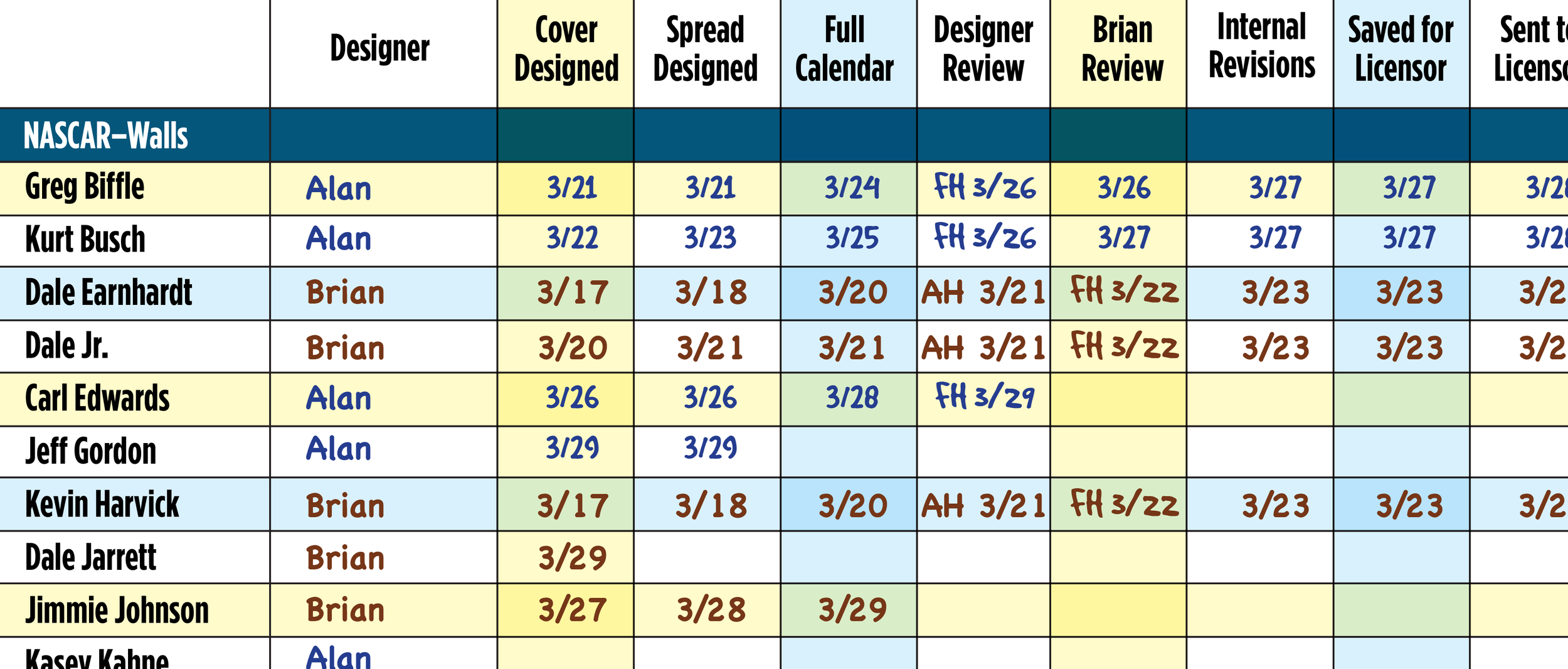
PRODUCTION TRACKING MATRIX
Representative reconstruction of the approximately five-foot-tall, wall-mounted matrix used to track designer assignments and product progress through design, internal review, licensing approval, and production.
Selling the Line Before the Season Began
NASCAR's sales cycle began well before the assets needed to produce the final products were available. Catalogs and full-size front-and-back product mockups, known as blads, were required months before the racing season began so retailers could evaluate the assortment at actual size and plan how products would merchandise within displays and planograms.
After the program's first year, the previous year's products were typically used to represent the upcoming NASCAR assortment in sales materials, accompanied by a disclaimer that designs would be updated to reflect the new race season. Blads used the previous year's back cover marked FPO (For Position Only).
Once racing began and enough current-season photography became available, the new products could be designed using updated cars, paint schemes, sponsors, drivers, and other current assets. Whenever possible, the new designs maintained a visual connection to what had been presented during the earlier sales process.
EARLY RETAIL SELL-IN
Previous Year's Products
↓
Catalog + Full-Size Blads
↓
Retail Assortment / Planogram
CURRENT SEASON BEGINS
New Photography + Updated Assets
↓
Design Current Products
↓
NASCAR / Team Approvals
↓
Print Production
From Rapid Expansion to Longevity
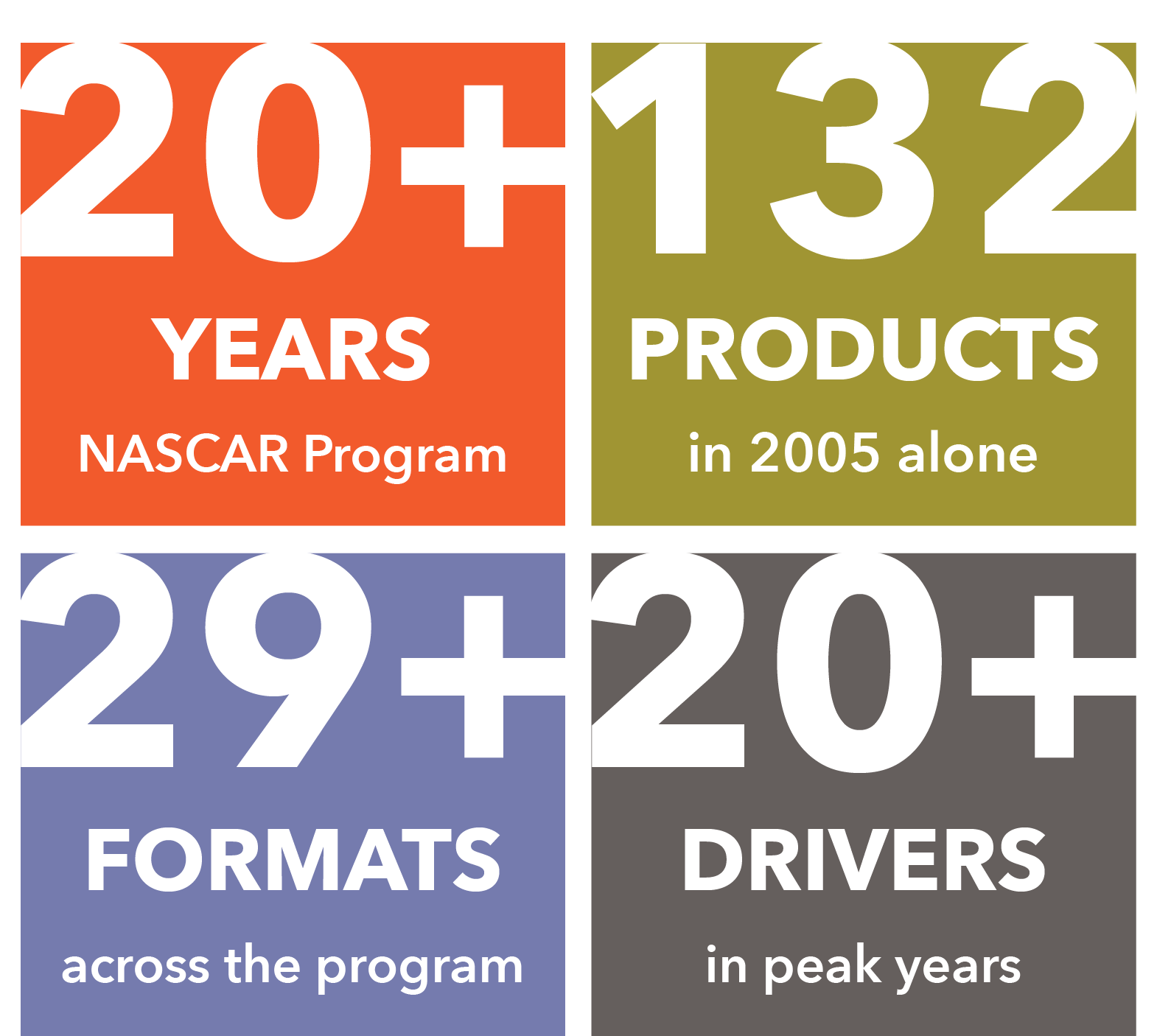
The NASCAR program expanded rapidly during its early peak years as new drivers and product formats were added. In 2005 alone, the assortment reached 132 NASCAR products.
As sales history established which products and formats performed best, the assortment was gradually refined. By 2009, approximately 60 NASCAR products appeared in the annual catalog, with additional non-dated formats offered separately.
The program continued for more than two decades, eventually contracting to only a few titles as the NASCAR market changed and major drivers retired.
Its longevity required continually refreshing the designs while responding to changing drivers, teams, sponsors, paint schemes, photography, style guides, and licensing requirements year after year.
From Product to Retail
The NASCAR program extended beyond product development into the way the assortment was presented and sold. I designed NASCAR catalog presentations, product mockups, packaging, point-of-purchase materials, retail displays, and trade-show graphics supporting the program.
NASCAR became TF Publishing's largest license in terms of product volume and format diversity and helped establish the company with major retailers.
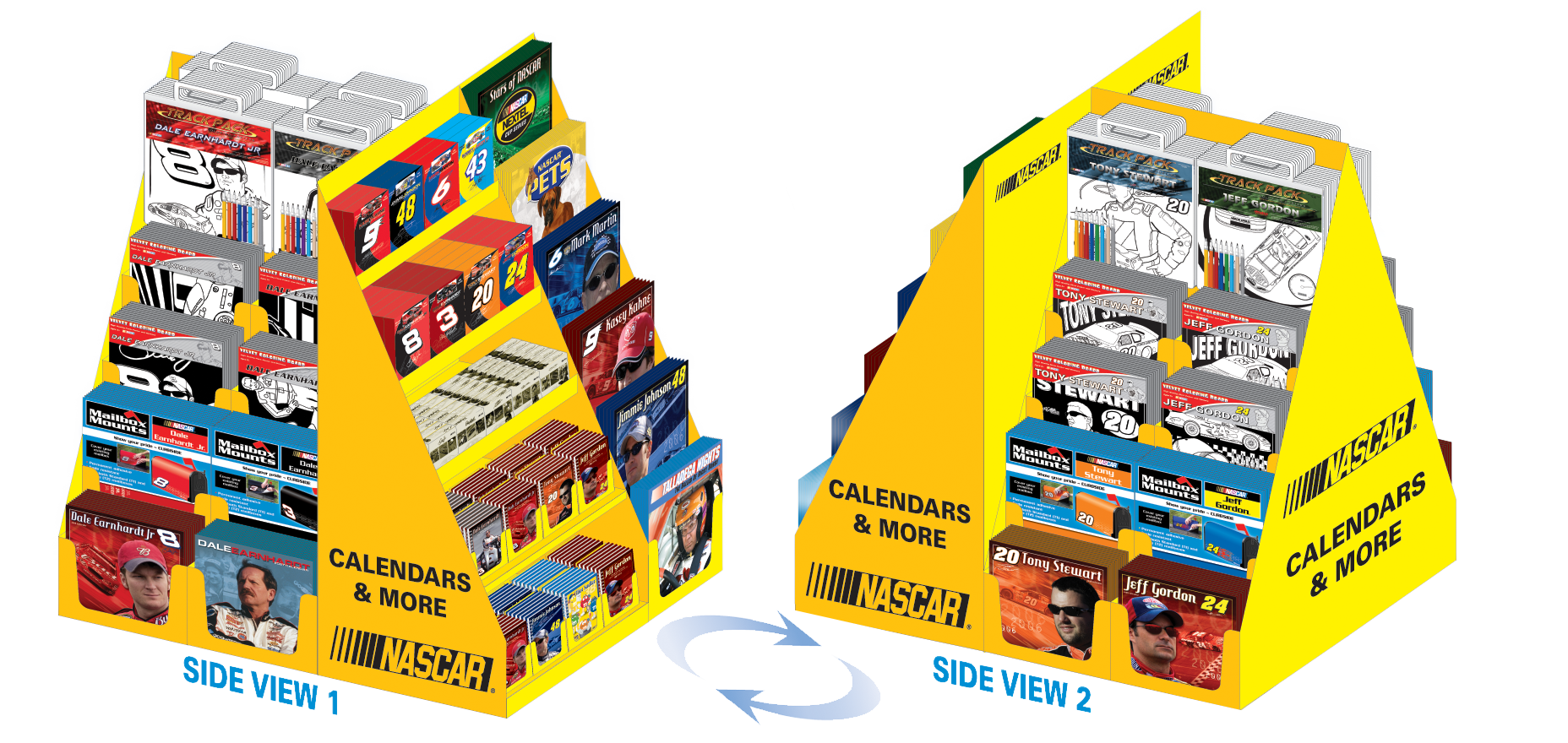
NASCAR FULL-PALLET DISPLAY — KMART
Designed to merchandise multiple NASCAR drivers and product formats within a single high-visibility retail presentation.
01 — NASCAR: RESULTS
More Than Two Decades of Continuous Reinvention
What began as a smaller licensing program grew into TF Publishing's largest licensed program by product volume and format diversity, spanning 20+ years, more than 20 drivers in peak years, and at least 29 documented product formats.
The program required far more than continually creating new designs. It required scalable creative systems, team coordination, production visibility, multiple levels of licensing approval, compressed production schedules, changing annual assets, and retail merchandising—all while keeping the assortment fresh from year to year.
For me, the program demonstrates the intersection of hands-on design, creative leadership, product development, workflow management, licensing, print production, and retail execution at significant scale.
02 — DAILY WORD PUZZLE
Automating a Complex Daily Calendar
Four puzzle types. 300+ days. One integrated production system.
When sales and licensing decided to consolidate the puzzle offering into a single daily calendar featuring four puzzle categories, I was responsible for developing the product and determining how it could be produced efficiently.
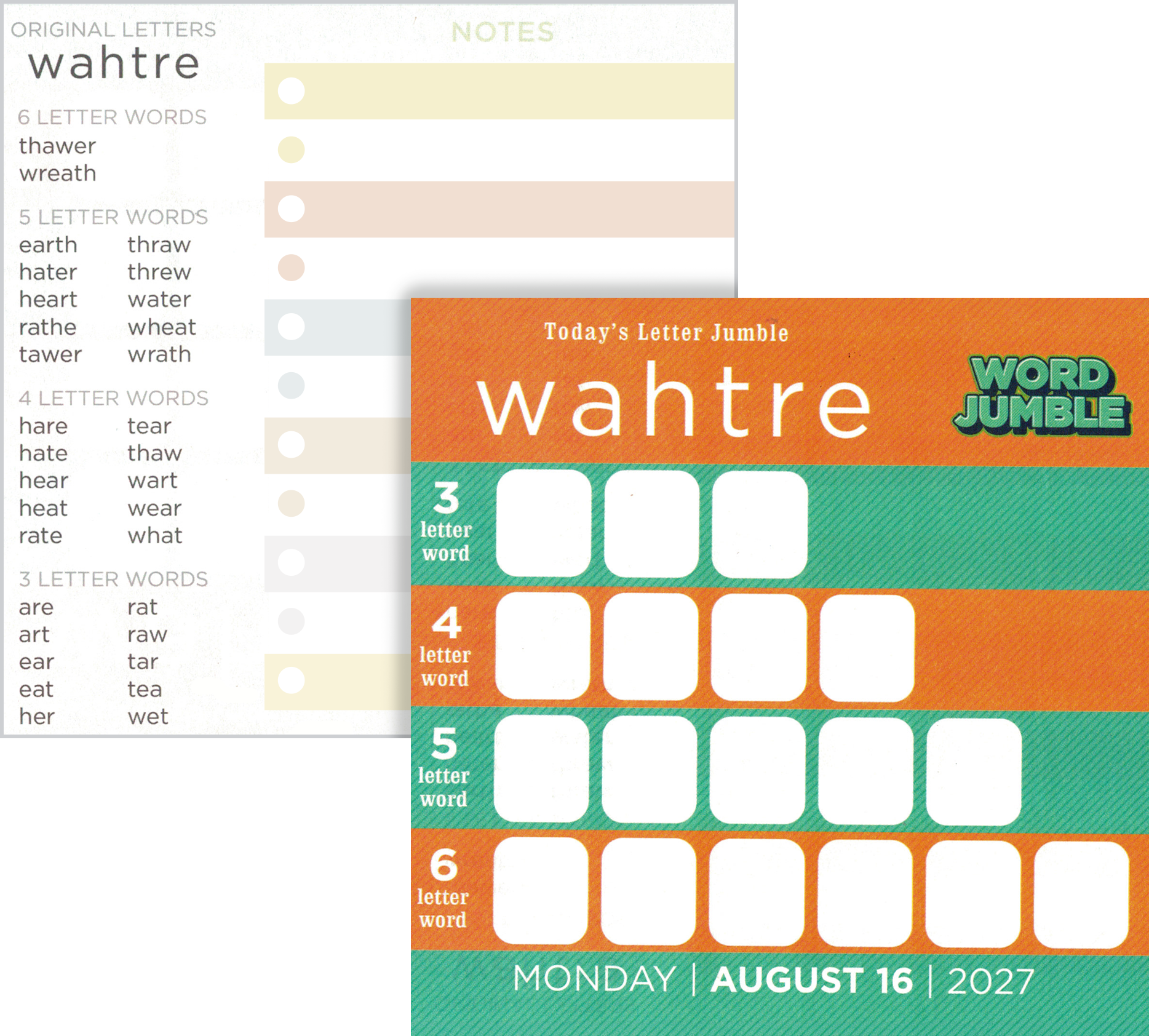
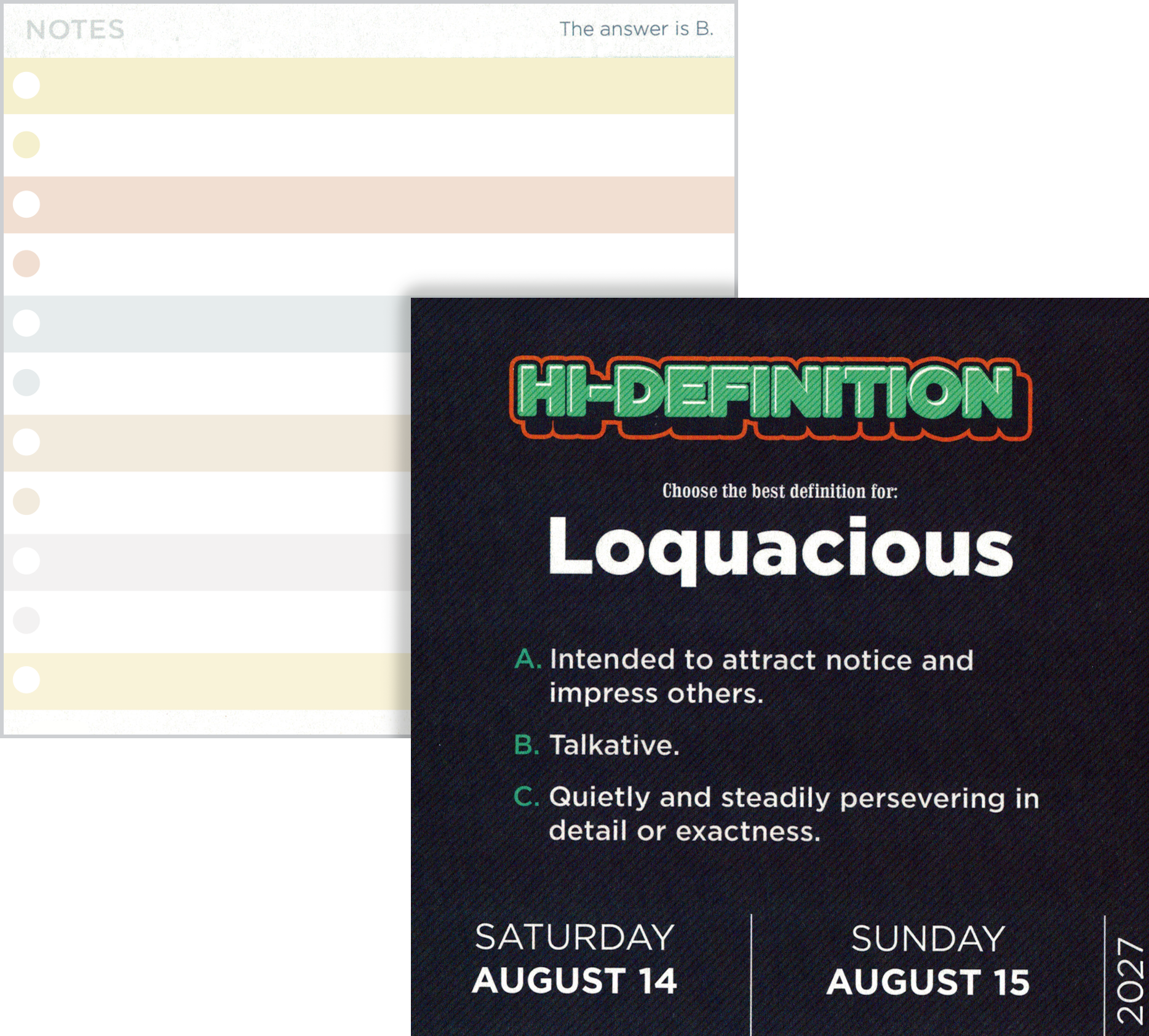
Three puzzle types—Crossword, Word Search, and Word Jumble—were available, but a fourth was needed. I conceived Hi-Definition, an original multiple-choice word game built around unusual words and their definitions, and developed its name, identity, content, and page design.
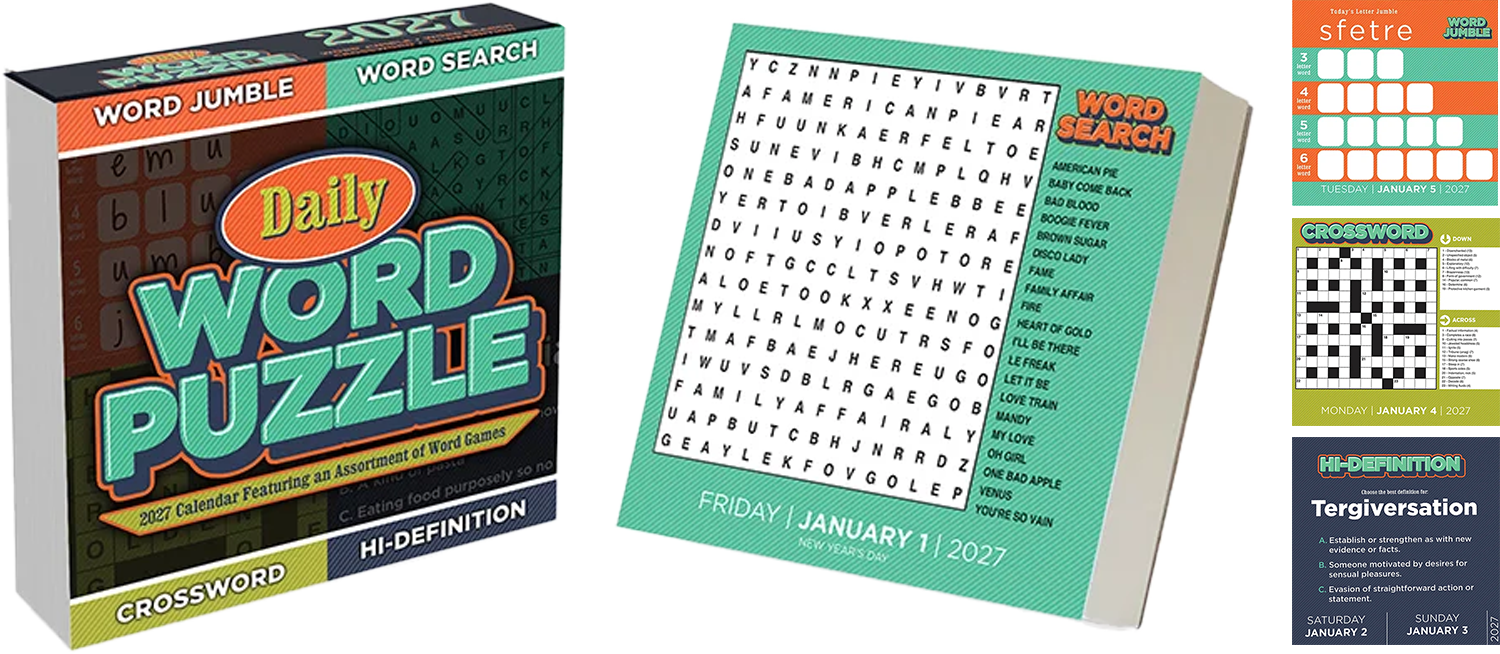
FOUR PUZZLES. ONE PRODUCT.
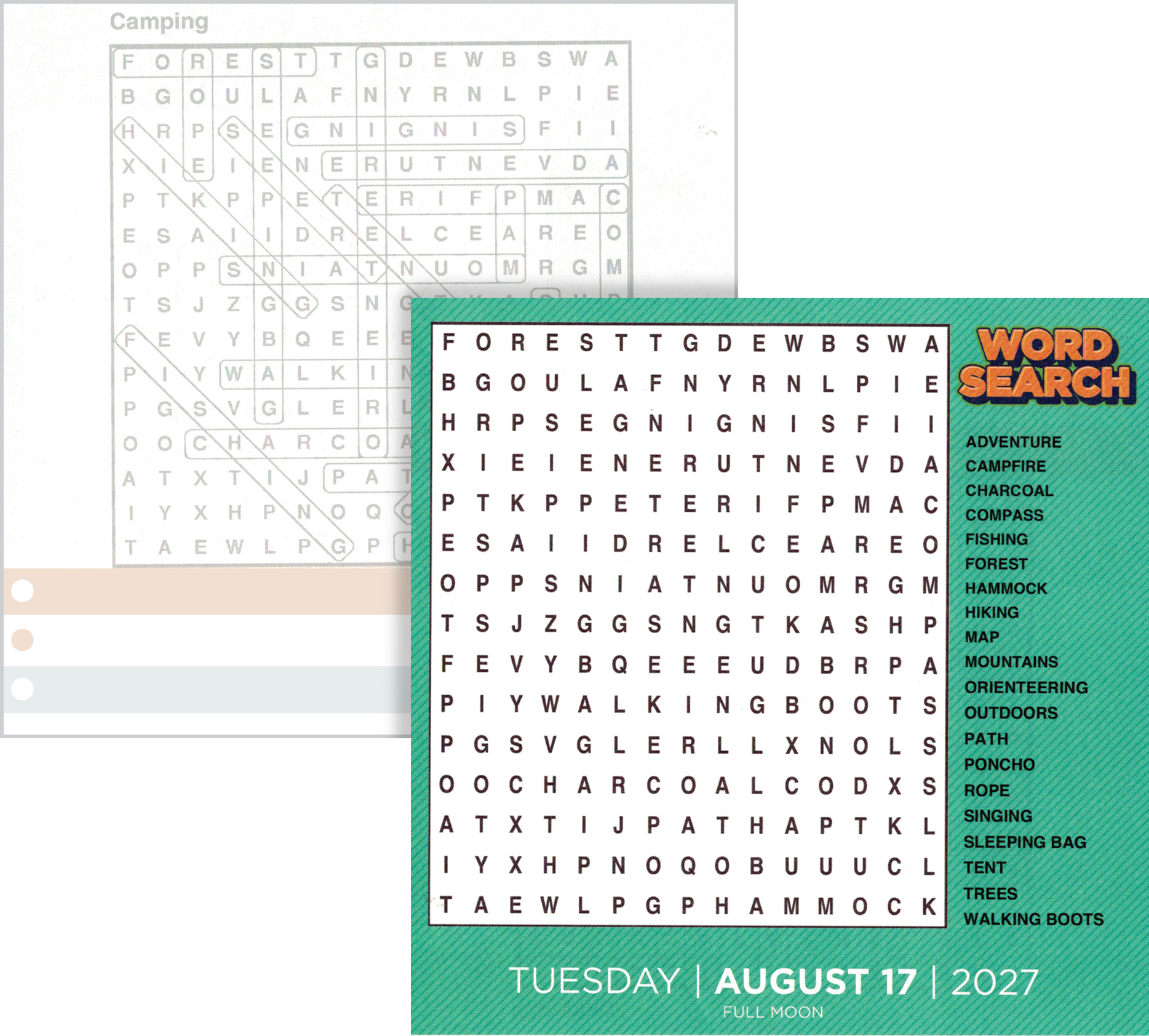
Four distinct puzzle formats were given individual identities within a shared visual system.
Four Different Puzzles. Four Different Systems.
Each puzzle type required a different page structure and production method. I created coordinated branding and individual title treatments for all four while establishing a shared color palette and visual system that allowed them to function as one cohesive product.
Crossword and Word Search content was purchased outright by the company, while Word Jumble content was generated in-house from six-letter source words and their possible three-, four-, five-, and six-letter combinations. Hi-Definition was developed entirely in-house, with new content researched and created by me each year.
The Word Search presented an additional technical challenge: multiple data-merge image elements were used on each page to rearrange the supplied puzzle components to fit the established page layout.
But designing four puzzle formats was only part of the challenge. More than 300 puzzle fronts, corresponding answer backs, dates, holidays, and puzzle types still had to be assembled in the correct sequence.
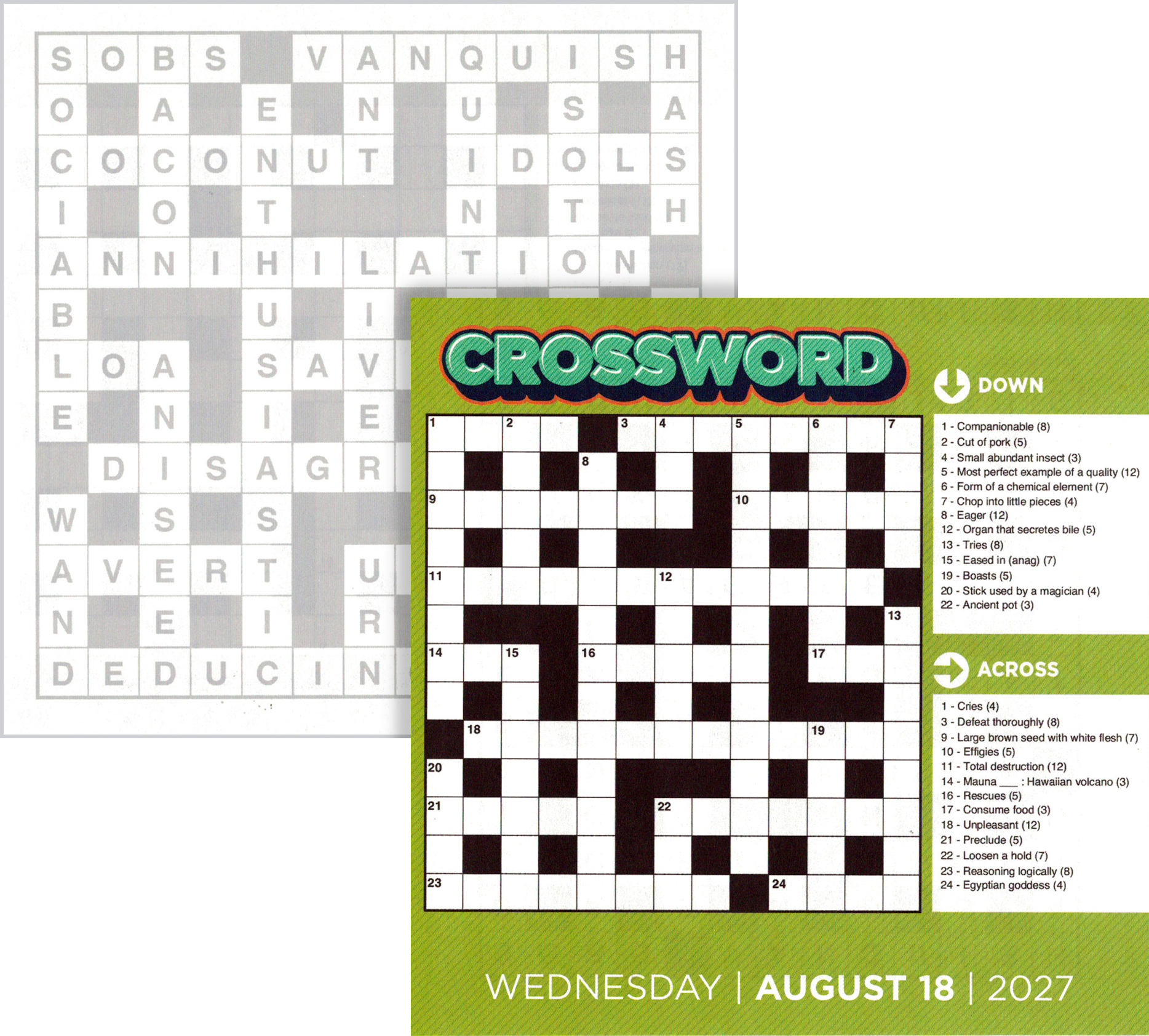
Building an Automated Production System.
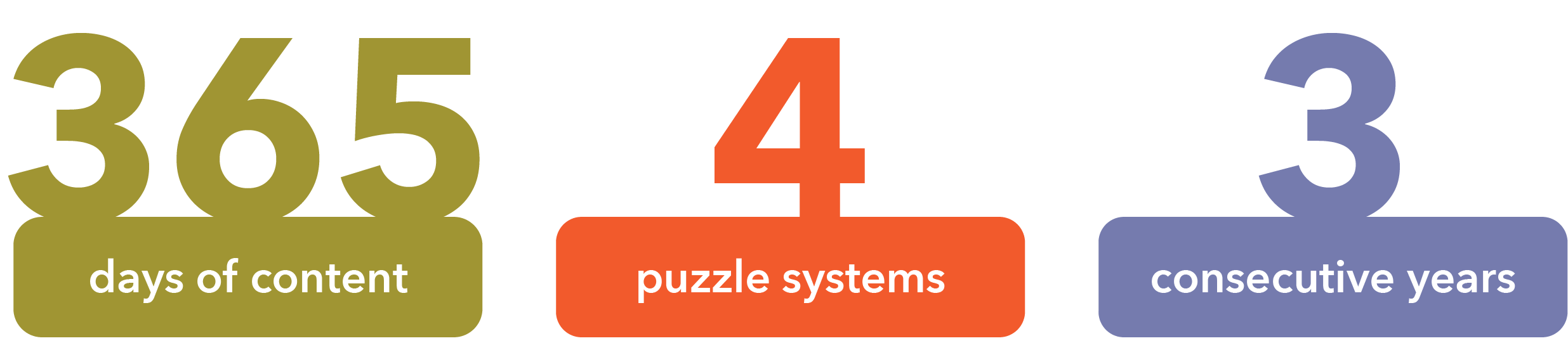
Designing the individual puzzle formats was only part of the challenge. Producing a 365-day calendar required hundreds of puzzle fronts, corresponding answers, and calendar dates to be assembled accurately and efficiently.
Rather than building each page manually, I developed an InDesign Data Merge workflow that combined designed templates with puzzle content, answers, and calendar information. Each puzzle format required its own data structure and assembly method, but all four worked within a controlled production system.
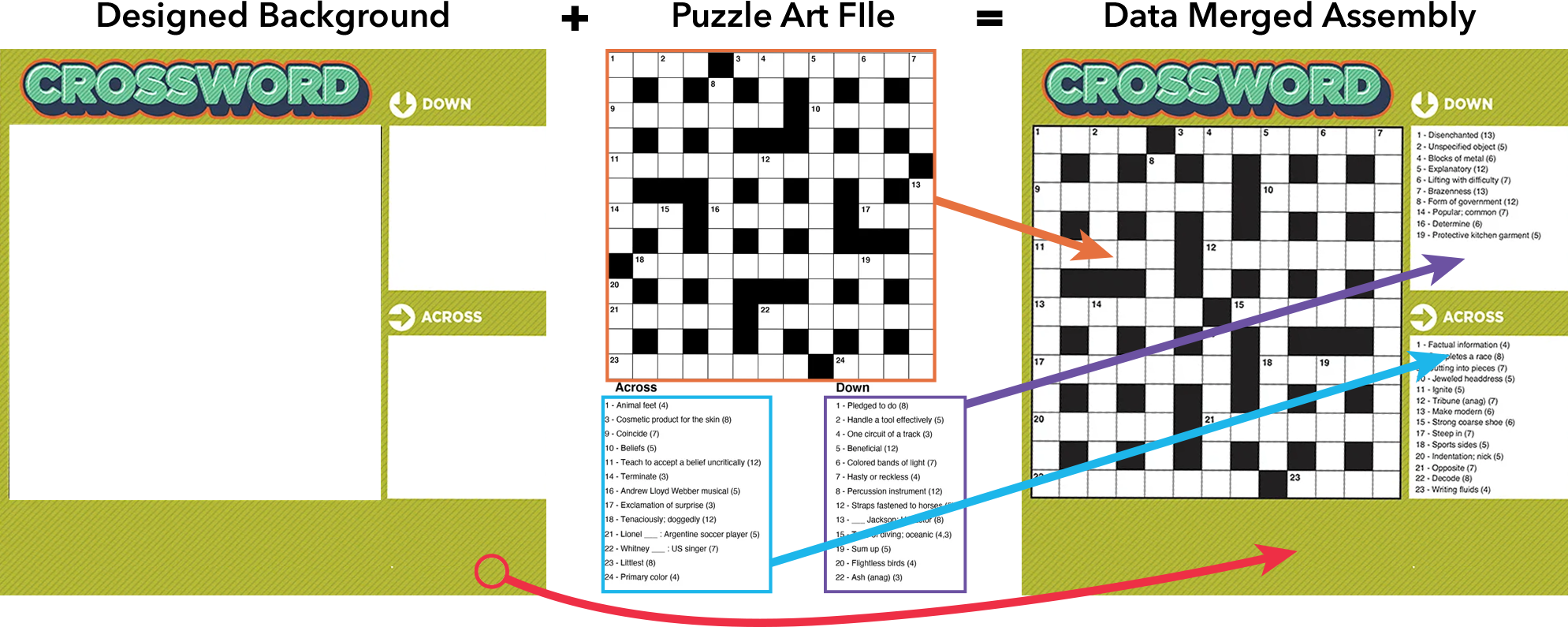
Complex puzzles such as Crosswords were assembled from multiple source elements, allowing the puzzle grid and clue sets to populate predetermined locations within the designed template.
From Template to Hundreds of Pages
Once the templates and source data were established, Data Merge could generate hundreds of individual pages while maintaining the design and structure of each puzzle type.
For text-based Hi-Definition pages, a single template populated the word, three possible definitions, correct answer, and calendar information. Moving from one record to the next changed the content while preserving the page design automatically.
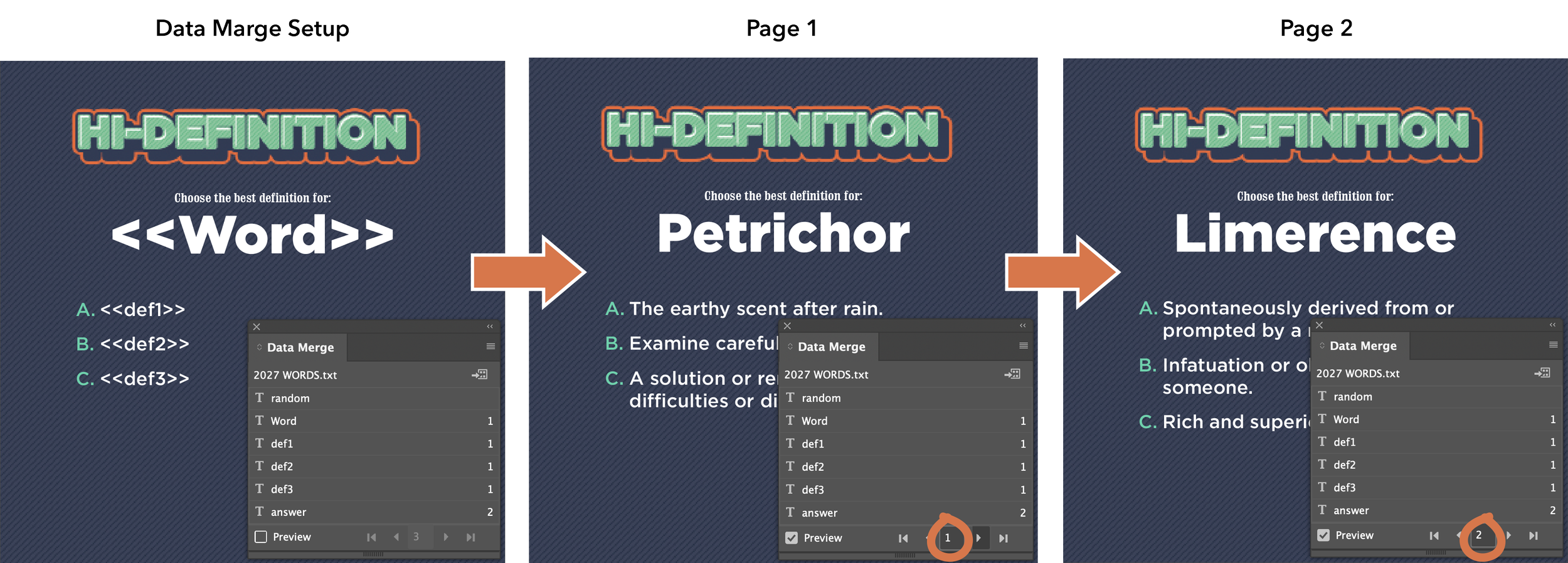
Built-In Accuracy
Data Merge in action: A single Hi-Definition template populated each day's word, definitions, answer, and calendar information from the source data.
With answers printed on the reverse of every page, maintaining the correct relationship between puzzle fronts and backs was critical.
The production data was structured so each puzzle remained linked to its corresponding solution. For image-based puzzles, file names and locations controlled which assets Data Merge placed. If an expected file could not be found, Data Merge generated an error report identifying the missing asset, while InDesign's Live Preflight provided an additional production check.
The automated relationship reduced the risk of human error from manually placing hundreds of individual puzzle and answer files. Completed files were also reviewed by a proofer before production.
Designed for Repeatability
The system wasn't built for a single production cycle. The Daily Word Puzzle calendar was produced for three consecutive years, with the established templates and workflow providing the foundation for each new edition.
The purchased Word Search and Crossword libraries contained 315 puzzles of each type, so I varied the selections between editions whenever possible. Word Jumble offered additional flexibility because the six source letters could be rearranged while retaining the same valid word combinations.
Hi-Definition, which I conceived and developed as the fourth puzzle category, provided additional content and occupied the weekend pages. The other three puzzle types alternated through the weekdays so each was used equally throughout the calendar.
02 — DAILY WORD PUZZLE: RESULTS
What began as a 365-day design challenge became a repeatable production system that combined creative development, data management, automation, and production controls.
By separating the visual templates from the variable puzzle content, I could efficiently generate hundreds of unique pages while maintaining consistent design, accurate front-to-back relationships, and a workflow that could be reused for subsequent editions.
The calendar was produced for three consecutive years and remained an active title when I left TF Publishing.
03 — LEADING THROUGH CHANGE
Keeping hundreds of products moving through an unusually challenging production year
Challenges are expected when leading a creative team. But one year brought an unusual combination of circumstances that affected staffing, workflow, production, and scheduling at the same time.
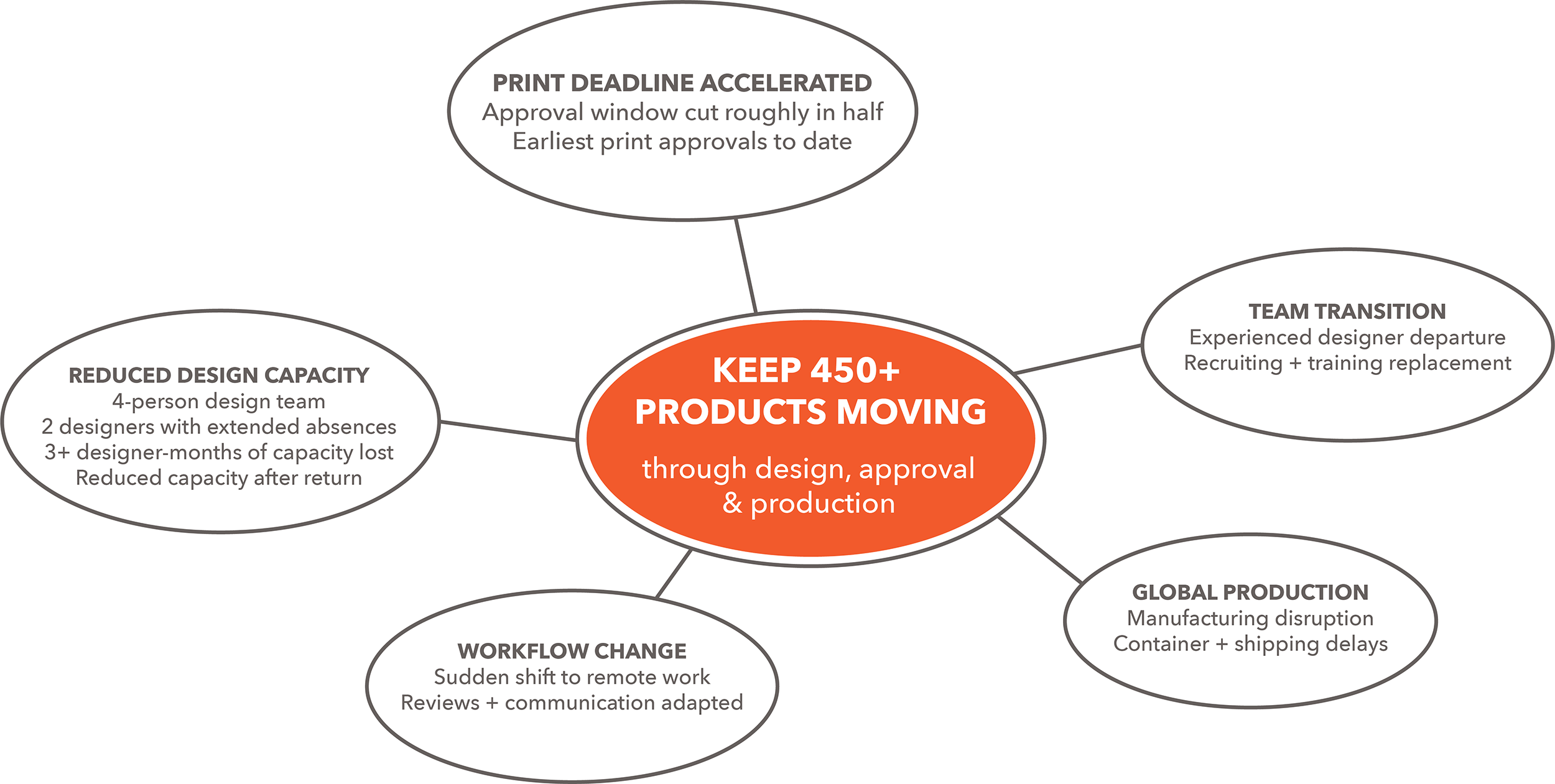
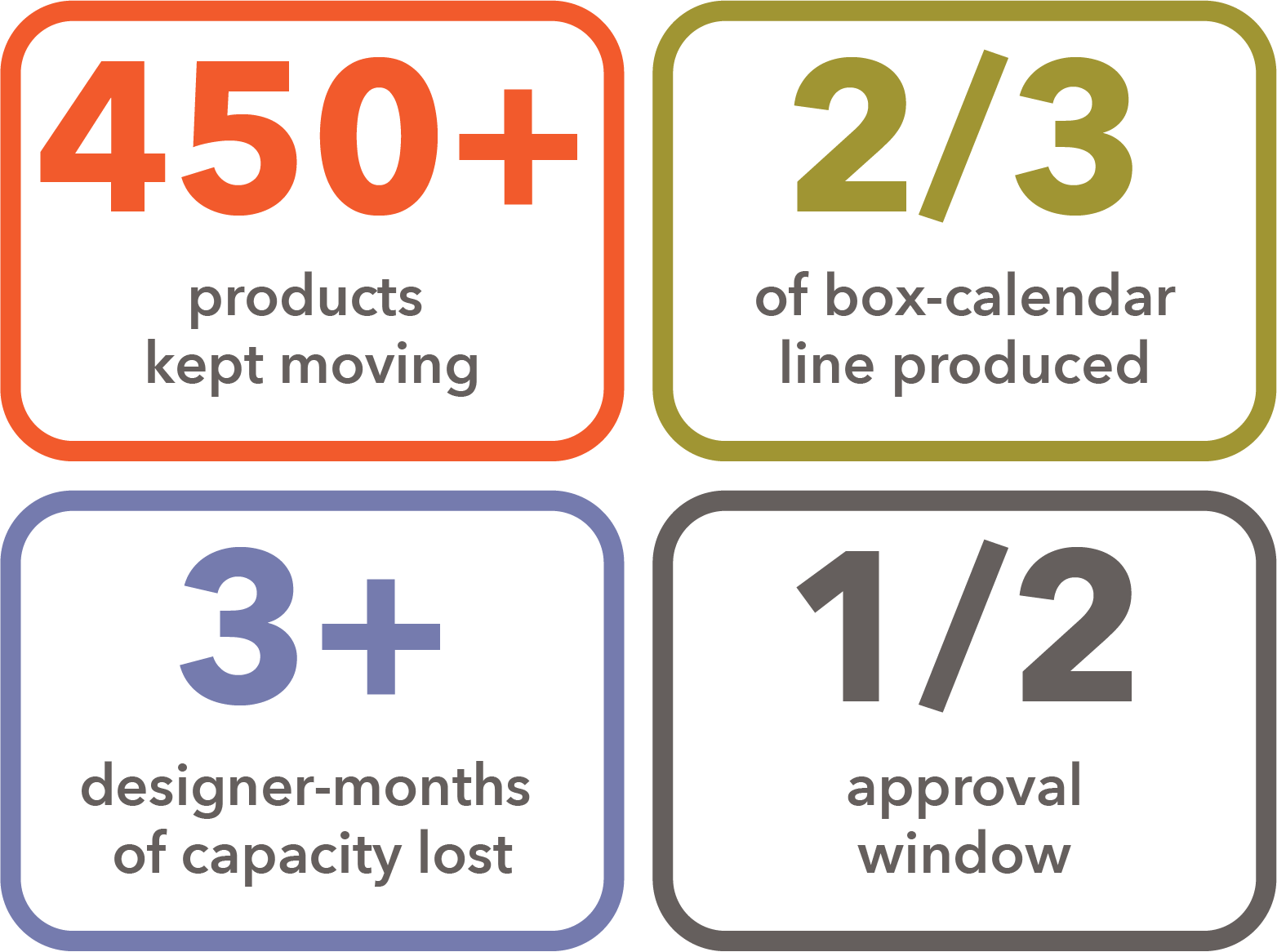
The challenge wasn't any single event. It was managing several significant disruptions simultaneously while keeping more than 450 products moving through design, approval, and production.
The Challenge
The creative department was a four-person design team, so changes in staffing had an immediate impact on available capacity. An experienced designer left when the company relocated, requiring the recruitment and training of a replacement. Later, two designers had extended absences totaling more than three designer-months of lost capacity, followed by reduced capacity after their return.
At the same time, the company transitioned to remote work for the first time, with no established remote-work processes in place. Reviews, communication, file management, and day-to-day coordination all had to be adapted quickly while production continued.
Global manufacturing and shipping disruptions added another layer of uncertainty to production schedules.
But the most significant scheduling challenge came when the window for sending products to print and providing final print approval was compressed from roughly two months to one, requiring the earliest print approvals we had ever completed.
My Response
The goal remained the same: keep more than 450 products moving without sacrificing the controls needed to move hundreds of them accurately through production.
With the accelerated production schedule, I reprioritized my own workload first, completing my remaining assigned titles within approximately a week and a half. I then shifted my capacity to the area where it could have the greatest impact on the team.
Because I was the most experienced with data merge and complex file setup, I took responsibility for most of the remaining daily box calendars—the most time-consuming product line—allowing the other designers to remain focused on completing their assigned products. By the end of the cycle, I had produced approximately two-thirds of the entire box-calendar line.
At the same time, I continued directing priorities, simplifying projects where appropriate, redistributing work as team capacity changed, and maintaining visibility into where products were in the development and approval process. Existing tracking, review, and approval systems helped prevent work from being lost or overlooked as responsibilities shifted.
When the team moved to remote work, those systems provided continuity. Reviews, communication, file management, and coordination changed location, but the underlying workflow remained intact.
The accelerated print schedule required the team to finish production earlier than ever before, coordinating design completion, internal reviews, licensing approvals, printer files, proofs, and final print approvals within the compressed timeframe.
04 — CHRONO CURE
Developing an Original Cooperative Tabletop Game
Four Eras. One Interconnected Timeline
Chrono Cure moves through the Stone, Classic, Industrial, and Future Ages. Each era has its own visual identity, environment, and gameplay conditions while remaining part of a single interconnected timeline.
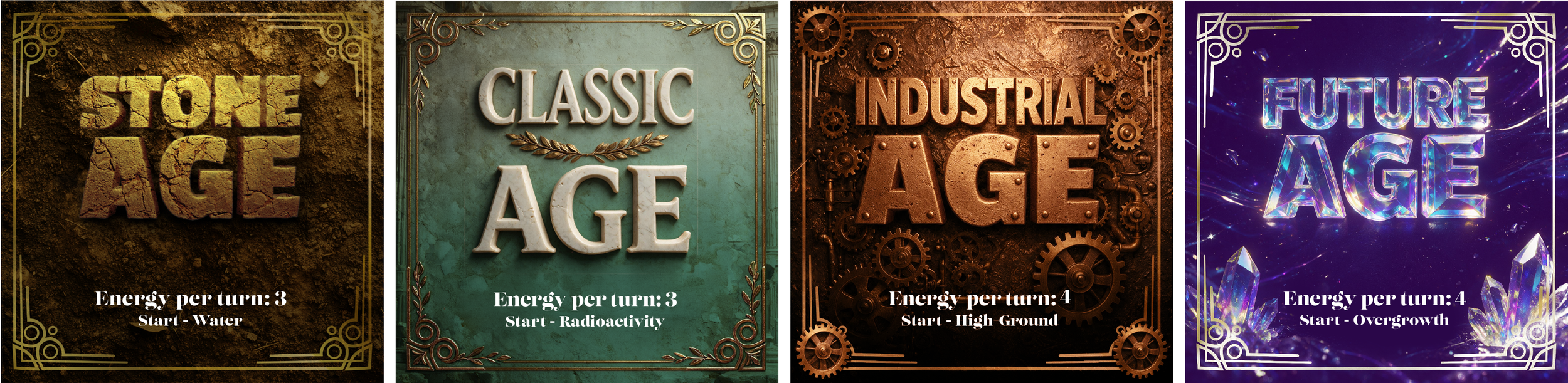
STONE • CLASSIC • INDUSTRIAL • FUTURE
Distinct color palettes and visual treatments differentiate each era while a consistent structure keeps them connected as one game system.
Building an Ever-Changing Timeline
The four eras aren't independent stages. Changes to one point in time can affect what players encounter, what their characters can do, and even what they know about the final solution.
Past actions reshape the future. Obstacles introduced in an earlier era carry forward into later eras, where they can interact with other obstacles and create different combinations of effects.
Roles evolve through time. Each character's abilities change depending on the era. The Engineer, for example, becomes more capable as technology advances, tying player abilities directly to the timeline.
Each game develops differently. The pool of available tiles is larger than the number used in a single game, changing the obstacles, interactions, and decisions players encounter from one playthrough to another.
The solution will change during play. Each discovered Shard changes the active solution based on where it is found in the timeline. Altering the past can also cause previously discovered Shards to disappear—changing both the solution and the information available to the team.
Turning Gameplay Into a Visual System
The visual design needed to communicate different types of gameplay information while making the board, cards, tiles, tokens, and player elements feel like parts of the same world.
Recurring typography, ornamental frames, compass and clock motifs, iconography, and component structures create continuity across the system. Color, imagery, and environmental details provide differentiation between eras, card types, and gameplay functions.
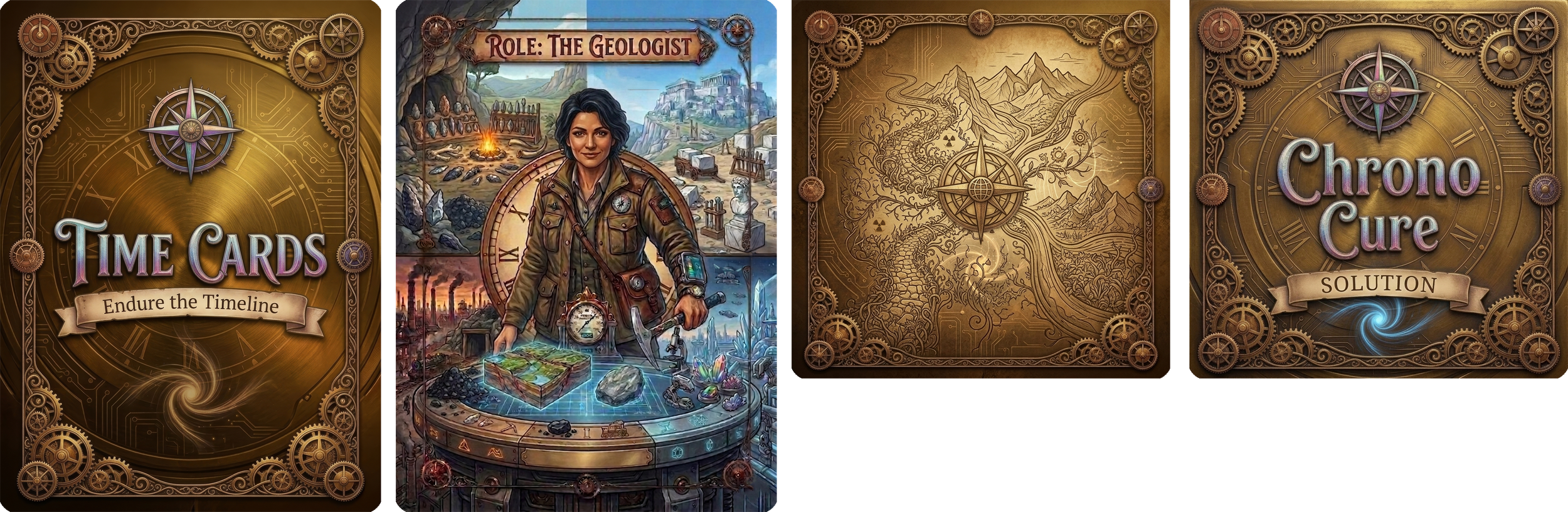
A COHESIVE COMPONENT SYSTEM
Different card types serve different gameplay functions while recurring visual elements, typography, and iconography connect them to a unified game identity.
From Game System to Physical Product
The project extended from gameplay and individual components to the complete physical experience. Board, cards, tiles, tokens, player pieces, and packaging were developed as parts of a coordinated system rather than as isolated graphics.
The packaging brings the game's four eras together into a single visual identity, carrying the concept from the tabletop to a finished consumer product.
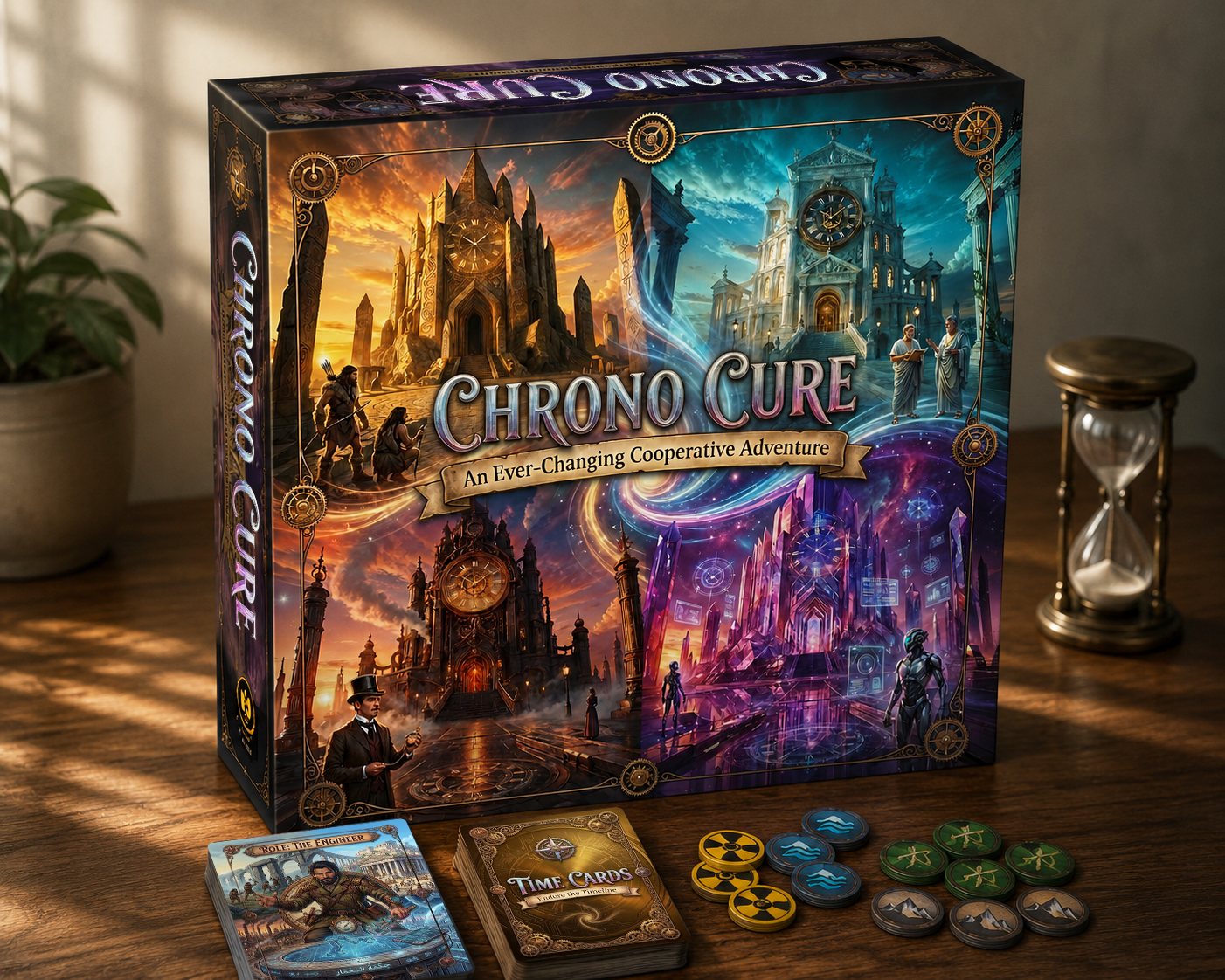
FROM GAMEPLAY TO FINISHED PRODUCT
Packaging, components, and visual identity come together as a cohesive tabletop experience.
Building gameplay, visual systems, and physical components around an ever-changing timeline.
Chrono Cure is an original cooperative tabletop game concept built around time travel and cause-and-effect across four eras. Players work together to overcome obstacles and uncover the solution needed to repair the timeline.
I developed the game concept, gameplay structure, component system, and visual direction, then designed the board, cards, tokens, player roles, packaging, and supporting game elements.
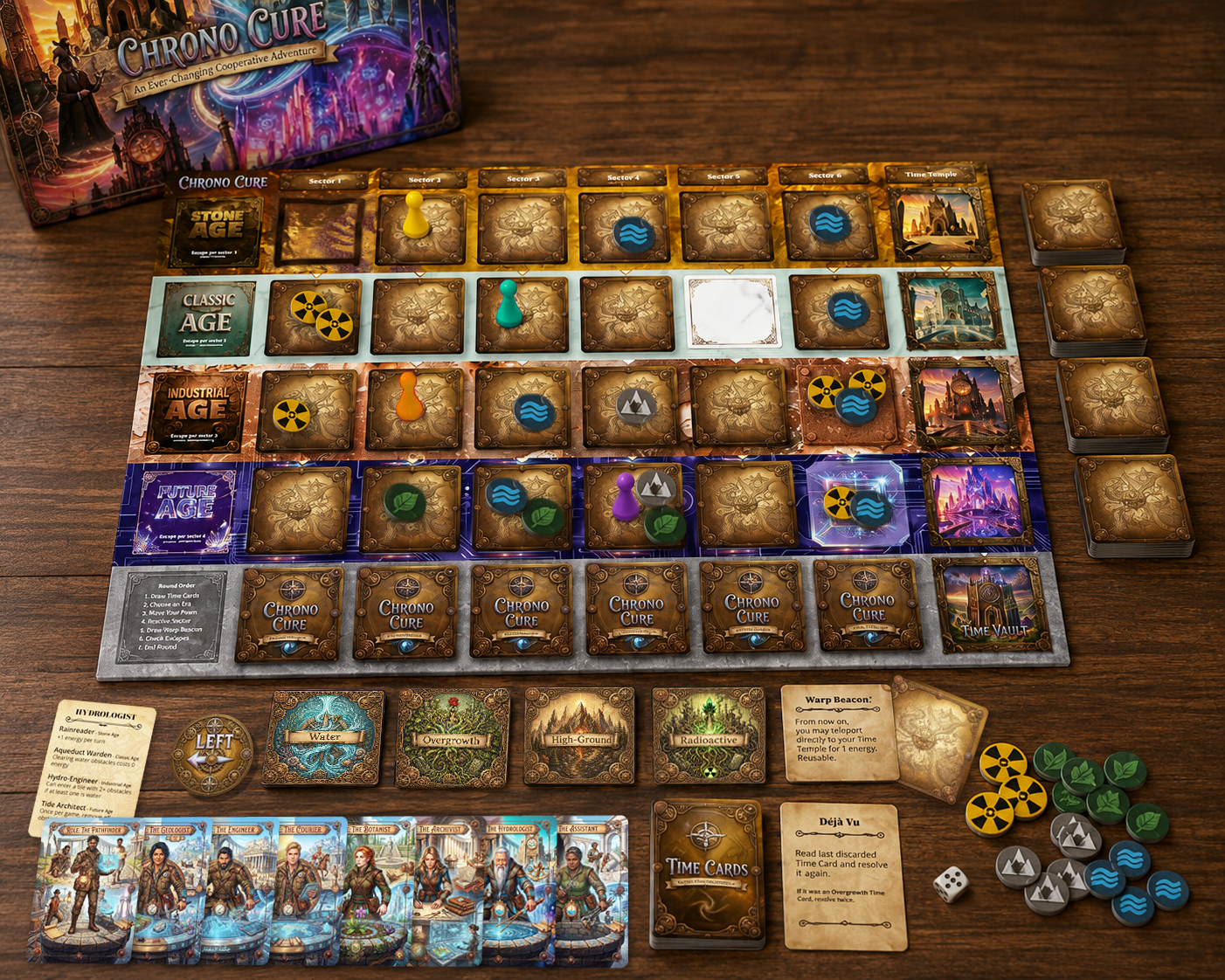
CHRONO CURE — AN EVER-CHANGING COOPERATIVE ADVENTURE
A cooperative tabletop system spanning four interconnected eras, with changing obstacles, resources, player roles, and possible solutions.
04 — CHRONO CURE: RESULTS
An Integrated Game and Design System
Chrono Cure developed from an original gameplay concept into a complete tabletop system connecting mechanics, visual communication, component design, and packaging.
The project demonstrates an approach to product development that goes beyond individual graphics: establishing the underlying structure, considering how components interact, building repeatable visual systems, and carrying an idea through to a cohesive physical product.
Visual development note: AI-assisted imagery was incorporated into portions of the artwork development. Game concept, gameplay, art direction, graphic design, typography, component architecture, iconography, packaging, and the overall visual system were developed and directed by me.